Getting an insurance claim denial feels like a punch to the gut — especially when you’ve been paying premiums on time and genuinely need the payout. You followed the rules, submitted your documents, and still got a rejection letter with a bunch of fine print explaining why you’re not getting your money.
If that sounds familiar, this guide is for you — specifically policyholders in India who are dealing with a denied claim and don’t know where to go next.
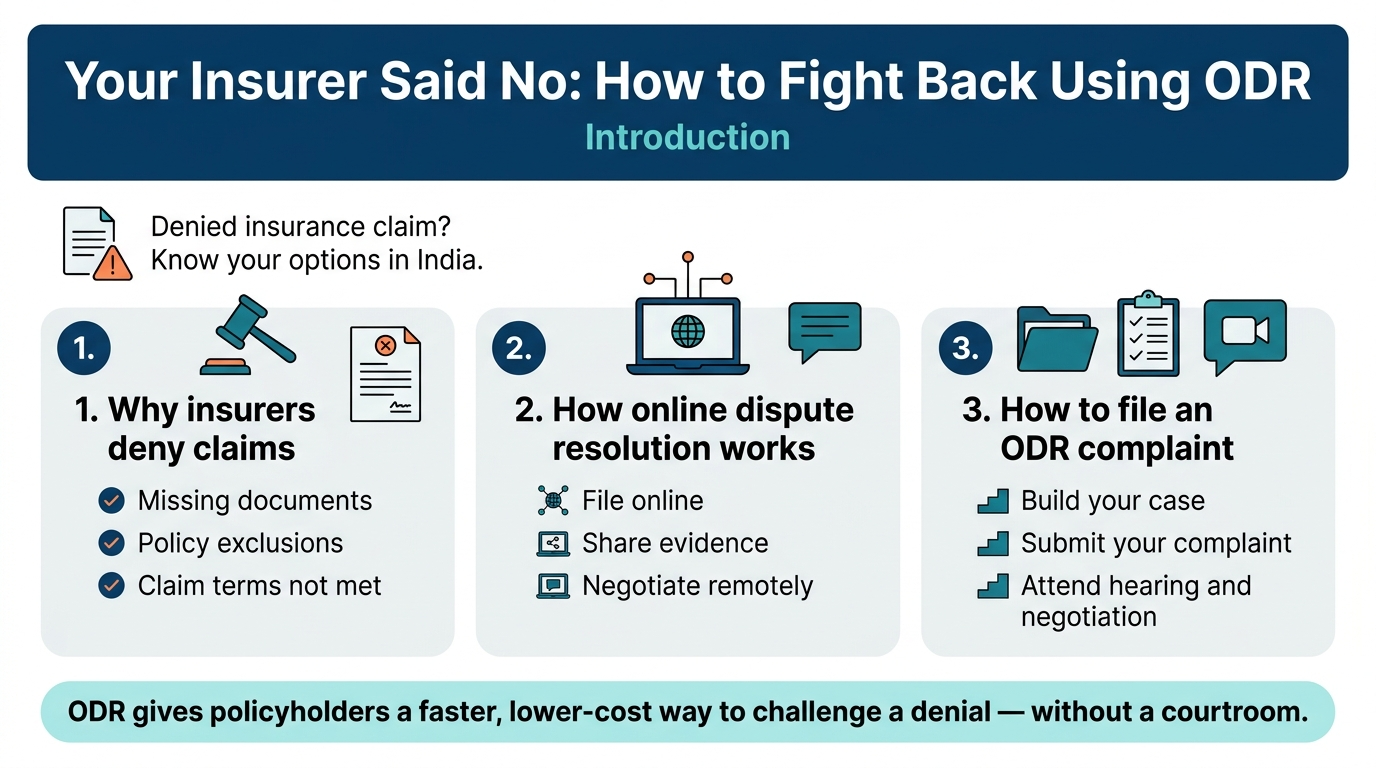
Here’s what we’ll walk you through:
- Why insurers deny claims — and how to spot whether the reason actually holds up
- How online dispute resolution for insurance works — so you know exactly what you’re stepping into before you file anything
- How to file an ODR complaint step by step — from putting together your case to handling the hearing and negotiation stage
Fighting an insurance claim denial doesn’t have to mean hiring a lawyer or sitting in a courtroom. The insurance dispute resolution process has moved online, and that’s actually good news for you. ODR gives everyday policyholders a real shot at appealing an insurer’s decision — without the cost and hassle of traditional legal routes.
Let’s break it all down.
Understanding Why Insurers Deny Claims
Common Reasons Behind Insurance Claim Rejections
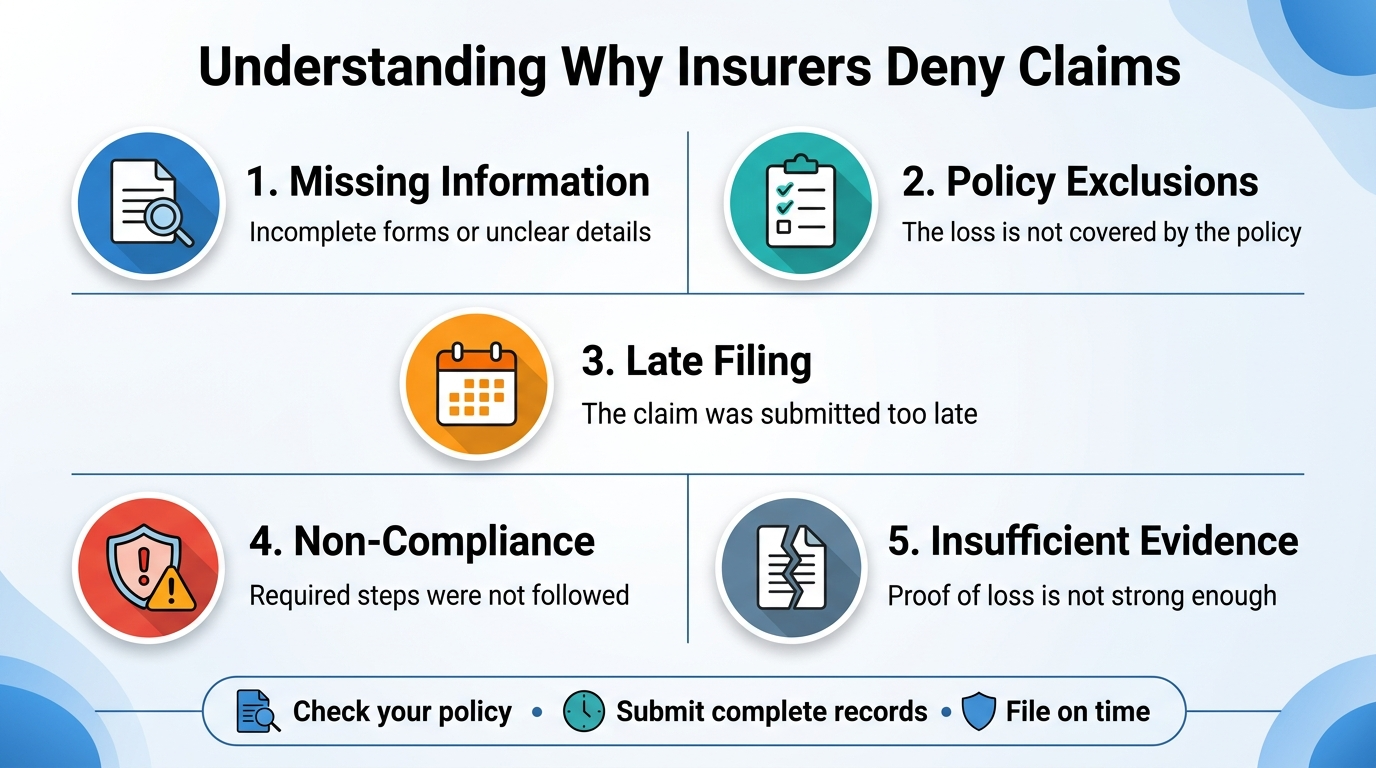
Before you can effectively fight an insurance claim denial, you need to understand why it happened in the first place. Insurers don’t reject claims arbitrarily — they operate within defined policy frameworks, and their decisions, while frustrating, are usually rooted in specific contractual or procedural grounds. Recognizing these grounds is the critical first step in building your case for an insurance dispute resolution process.
Here are the most frequently cited reasons behind insurance claim rejections:
Policy Exclusions and Coverage Gaps
One of the leading causes of insurance claim denial is that the incident or loss falls under a policy exclusion. Every insurance policy contains a list of scenarios it does not cover. These exclusions can be broad or highly specific, and policyholders often don’t fully read or understand them until a claim is denied.
Common exclusions include:
- Pre-existing conditions (health insurance)
- Flood or earthquake damage under standard homeowners’ policies
- Intentional damage or self-inflicted loss
- Business-related losses under personal policies
- Acts of war or government action
Understanding what your policy explicitly excludes is essential before you challenge a denial. If your claim legitimately falls under an exclusion, your strategy going forward will be different than if you believe the exclusion was misapplied.
Lapsed or Invalid Policy at the Time of the Claim
An insurer may deny a claim if your policy was not active when the incident occurred. This can happen due to:
- Missed premium payments
- Administrative errors causing an unintended lapse
- Policy cancellation without proper notice to the policyholder
In some of these scenarios — particularly if the lapse was due to an insurer’s error or inadequate cancellation notice — you may have strong grounds to challenge the denial through a formal insurance dispute resolution process or online dispute resolution (ODR) platform.
Incomplete or Inaccurate Documentation
Insurers require specific documentation to process claims. When that documentation is missing, insufficient, or contains errors, the claim can be denied. Typical documentation issues include:
- Missing medical records or receipts
- Incomplete claim forms
- Insufficient proof of loss (e.g., no photos, no police report)
- Discrepancies between the claim form and supporting documents
This type of denial is particularly common and, importantly, often reversible. If you can supply the missing documentation or correct the inaccuracies, you have a clear path to appealing the insurer’s decision.
Late Filing or Missed Deadlines
Most insurance policies include strict deadlines for reporting incidents and filing claims. If you miss these windows — even by a short period — the insurer may use it as grounds for denial. However, certain jurisdictions have consumer protection laws that restrict how strictly insurers can enforce these deadlines, especially in cases involving hospitalization, disability, or genuine emergency.
Misrepresentation or Non-Disclosure
If the insurer believes the policyholder provided false information during the application process or at the time of the claim, they can deny the claim on the basis of misrepresentation. This is a serious allegation that, if unfounded, gives you strong grounds to dispute through formal channels.
Disputed Liability or Causation
In property and casualty claims, insurers may deny a claim by arguing that the cause of the loss isn’t covered. For instance, they may claim that water damage was due to poor maintenance (not covered) rather than a sudden pipe burst (covered). These disputes over causation are among the most common in insurance claim denial cases and often require expert evidence to resolve.
How to Interpret Your Insurer’s Denial Letter
Receiving a denial letter can feel overwhelming, but this document is actually one of your most valuable tools. A well-analyzed denial letter tells you exactly what the insurer is claiming — and where their argument may be weak. Learning how to fight insurance denial starts with reading this letter carefully and strategically.
What a Denial Letter Must Contain
In most jurisdictions, insurers are legally required to send a written denial that includes:
| Element | What It Means for You |
|---|---|
| Specific reason(s) for denial | The exact grounds the insurer is relying on |
| Policy provisions cited | The section(s) of the policy used to justify the decision |
| Information on your appeal rights | Details on how and when you can formally challenge the denial |
| Contact information | Who to reach out to for clarification or further action |
If any of these elements are missing from your denial letter, that omission itself could be a procedural violation — one you can raise during the ODR complaint filing or formal appeal process.
Breaking Down the Language
Insurance denial letters are often written in dense legal and policy language. Here’s how to approach them:
-
Identify the stated reason clearly. Look past the formal language to identify the core argument. Is it a coverage issue? A documentation issue? A timeliness issue? Categorizing the reason helps you target your response.
-
Find the exact policy clause referenced. Cross-reference the clause the insurer cited with your actual policy document. Read the clause in full context — sometimes insurers misapply clauses or cite them out of context.
-
Look for ambiguity. Insurance contracts are interpreted against the insurer (a legal principle known as contra proferentem) when language is ambiguous. If the clause cited is unclear or open to interpretation, this is a significant point in your favor.
-
Note every deadline mentioned. Denial letters typically specify time limits for filing an appeal or complaint. Missing these deadlines can forfeit your right to challenge the decision, so mark them immediately.
-
Check for inconsistencies. Does the reason given in the denial letter match what you were told verbally? Are there inconsistencies between the denial and prior communications with your insurer? Document everything.
Red Flags That Signal a Challengeable Denial
Not every denial is final or justified. Watch for these red flags that suggest the denial may be worth challenging:
- The reason given is vague or generic without specific policy language
- The insurer failed to conduct a proper investigation before denying
- The denial arrived unusually quickly after the claim was filed
- The cited policy exclusion does not clearly apply to your situation
- You were not given adequate opportunity to provide additional documentation
Each of these scenarios could strengthen your case when appealing an insurer’s decision through formal channels, including an ODR platform.
Your Legal Right to Challenge the Decision
Many policyholders accept a denial as the final word — but this is a mistake. You have well-established legal rights when it comes to challenging an insurance claim denial, and understanding those rights is the foundation of any successful insurance claim appeal.
The Right to a Formal Internal Appeal
In most regulatory environments, insurers are required to offer a formal internal appeals process before a policyholder must seek external remedies. This means:
- You can request a review of the denial by a different claims adjuster or a senior review team
- The insurer must consider any new evidence or documentation you provide
- The insurer is typically bound by response timelines set by regulation
Taking full advantage of the internal appeal is important not just because it may resolve the dispute quickly, but because it also creates a formal record — one that will be useful if you later proceed to ODR or other external dispute resolution mechanisms.
The Right to External Dispute Resolution
If the internal appeal doesn’t produce a satisfactory result, you have the right to escalate the dispute externally. This is where online dispute resolution for insurance becomes particularly relevant. ODR platforms provide a structured, accessible, and often faster alternative to traditional litigation, allowing policyholders to present their case to a neutral third party.
Your right to access these external mechanisms is protected in many jurisdictions through:
- Insurance regulatory frameworks that mandate access to external review
- Consumer protection laws that prohibit insurers from blocking external appeal rights
- Ombudsman schemes and ADR (Alternative Dispute Resolution) systems that offer binding or non-binding outcomes
Knowing that these avenues exist — and that you are legally entitled to use them — is the empowering first step in the insurance dispute resolution process.
The Right to Be Treated in Good Faith
Insurers are legally obligated to handle claims in good faith. This means:
- They must conduct a thorough and unbiased investigation
- They cannot deny claims without a reasonable basis
- They must communicate promptly and transparently with the policyholder
- They cannot use delay tactics to discourage legitimate claims
When an insurer breaches this duty — through unreasonable delay, misrepresentation, or bad faith denial — policyholders may have grounds not only to challenge the denial but to seek additional remedies. Documenting any potential bad faith conduct from the moment you receive a denial is a smart practice.
Statute of Limitations: Don’t Wait Too Long
Your right to challenge a denial is not unlimited in time. Every jurisdiction imposes a statute of limitations on insurance disputes — a deadline by which you must initiate formal proceedings. These timeframes vary, but acting promptly is always advisable. Delays can:
- Erode the strength of your evidence
- Result in lost witnesses or documentation
- Lead to an automatic forfeiture of your right to challenge
With this in mind, as soon as you receive a denial letter, begin your timeline. Review the appeal deadlines in the letter, understand the applicable regulatory timelines in your jurisdiction, and start preparing your documentation without delay.
Summary: Key Rights at a Glance
| Your Right | What It Allows You to Do |
|---|---|
| Right to internal appeal | Request a formal review within the insurer’s own process |
| Right to external dispute resolution | Escalate to ODR, ombudsman, or regulatory body |
| Right to good faith handling | Challenge denials based on insurer misconduct or bad faith |
| Right to legal representation | Engage an attorney or consumer advocate during disputes |
| Right to information | Request the full claims file and all documentation used in the denial decision |
What Is Online Dispute Resolution (ODR) and How It Works
Definition and Purpose of ODR in Insurance Disputes
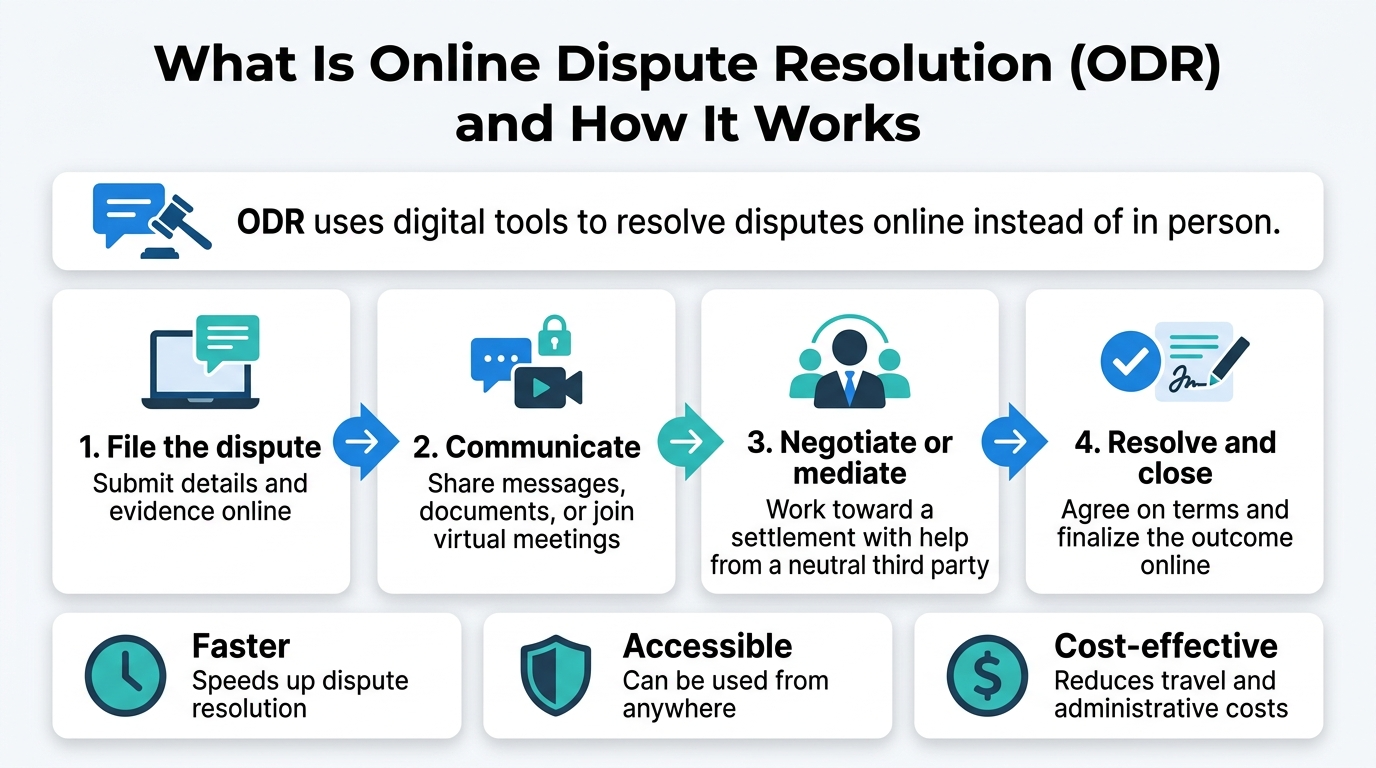
Online Dispute Resolution (ODR) is a structured, technology-driven mechanism that allows disputing parties — in this case, policyholders and insurance companies — to resolve conflicts without stepping into a courtroom or a traditional mediation office. At its core, ODR transplants the principles of Alternative Dispute Resolution (ADR) into a digital environment, making the process faster, more accessible, and significantly less expensive for all parties involved.
In the context of insurance disputes, ODR serves a very specific and critical purpose: it gives policyholders a formal, enforceable channel to challenge an insurance claim denial without the burden of hiring attorneys, waiting for court dates, or enduring months of back-and-forth correspondence. When an insurer rejects your claim — whether due to alleged policy exclusions, documentation gaps, or coverage disputes — ODR provides a structured path to present your case before a neutral third party who has the authority to review the decision.
The purpose of ODR in insurance disputes can be broken down into three core functions:
- Accessibility: Policyholders can file complaints, submit evidence, and attend hearings entirely online, removing geographical and logistical barriers.
- Efficiency: Timelines in ODR proceedings are significantly compressed compared to litigation, often resolving disputes within weeks rather than years.
- Neutrality: A certified ODR platform or regulatory body assigns impartial adjudicators or mediators who have no stake in the outcome, ensuring a fair review of the insurer’s decision.
It’s also important to understand that online dispute resolution for insurance is not a single, uniform system. Depending on your jurisdiction, ODR may be administered by:
- State or national insurance regulatory authorities
- Independent ODR platforms accredited by government bodies
- Internal insurer ODR portals mandated by law
- Consumer protection ombudsman offices operating digitally
The legitimacy and enforceability of ODR outcomes depend on which channel you use, which is why understanding the system before filing is essential. In most regulated markets, an ODR ruling issued by an official insurance ombudsman or regulatory body is binding on the insurer, though the policyholder typically retains the right to reject the outcome and pursue litigation if they choose.
Key Players Involved in the ODR Process
Understanding who participates in the insurance dispute resolution process is critical to navigating it effectively. The ODR ecosystem involves several distinct roles, each with defined responsibilities that keep the process balanced and fair.
The Policyholder (Complainant)
You — the individual or business whose insurance claim was denied — are the complainant in an ODR proceeding. Your role is to:
- Initiate the complaint by submitting a formal ODR application
- Provide all supporting documentation, including the original policy, denial letter, and any evidence supporting your claim
- Participate in scheduled online hearings or submit written arguments as required
- Respond to counter-arguments presented by the insurer
As the complainant, you bear the initial burden of demonstrating that the insurer’s denial was unjustified under the terms of your policy or applicable law. This is why preparing your case before filing an ODR complaint — which is covered in the next section — is so important.
The Insurance Company (Respondent)
The insurer whose decision is being challenged becomes the respondent in the ODR process. Their obligations typically include:
- Responding formally to the complaint within a stipulated timeframe
- Submitting their rationale for the claim denial, backed by policy language and documentation
- Participating in mediation or hearing sessions as directed by the ODR authority
- Complying with the final ruling if the ODR body has binding authority
It’s worth noting that insurers operating in regulated markets are generally required by law to cooperate with ODR proceedings. Failure to participate or comply can result in regulatory penalties, which gives the process genuine leverage on your behalf when you are fighting an insurance denial.
The ODR Neutral (Mediator or Adjudicator)
This is the impartial professional at the heart of the ODR process. Depending on the nature of the dispute and the platform used, the neutral may function as:
| Role | Function | Authority Level |
|---|---|---|
| Mediator | Facilitates negotiation between parties | Non-binding; assists in reaching voluntary agreement |
| Arbitrator | Reviews evidence and issues a decision | Binding on both parties (in binding arbitration) |
| Adjudicator/Ombudsman | Formally evaluates complaint and rules on it | Binding on insurer; optional for policyholder |
| Conciliator | Proposes settlement terms | Non-binding; parties may accept or reject |
The specific type of neutral assigned to your case will significantly influence how the ODR hearing and negotiation stage unfolds. Mediators give both parties more control over the outcome, while adjudicators function more like judges — reviewing the facts and issuing a ruling based on policy terms and applicable regulations.
The ODR Platform or Authority
This is the administrative body that hosts and manages the entire process. It could be a government-run insurance ombudsman office, a regulatory tribunal, or a private ODR platform accredited for insurance disputes. Their responsibilities include:
- Accepting and registering complaints
- Verifying eligibility and jurisdiction
- Assigning a qualified neutral
- Setting procedural timelines
- Facilitating secure document exchange and virtual hearings
- Issuing and recording the final decision
Choosing the right ODR platform or authority for your specific dispute is a foundational step — one that determines the enforceability of any resolution you achieve.
How ODR Differs From Traditional Legal Channels
With this in mind, it’s essential to clearly distinguish online dispute resolution for insurance from the conventional legal routes policyholders often consider when facing a claim denial. Many people default to hiring a lawyer and pursuing litigation without realizing that ODR offers a fundamentally different — and in many cases, far more practical — path.
Here is a direct comparison across the most important dimensions:
| Dimension | ODR | Traditional Litigation |
|---|---|---|
| Cost | Low to no cost for the complainant | High legal fees, court costs, expert witness fees |
| Time to Resolution | Weeks to a few months | Months to several years |
| Accessibility | Entirely online; no travel required | Requires in-person court appearances |
| Formality | Structured but flexible; less adversarial | Highly formal; governed by strict procedural rules |
| Representation | Can self-represent easily | Typically requires legal counsel |
| Privacy | Confidential proceedings | Court records are generally public |
| Enforceability | Binding on insurer in most regulated systems | Court judgments are fully enforceable |
| Expertise of Neutral | Insurance-specific adjudicators | General civil court judges |
| Emotional Burden | Lower; process is designed to be accessible | Higher; adversarial environment is stressful |
Why ODR Is Often the Smarter First Step
When you receive an insurance claim denial, your first instinct might be to consult a lawyer. While that is never a bad idea for complex cases, initiating an ODR complaint first offers several strategic advantages:
- It’s faster. If your claim is time-sensitive — for instance, a denied health insurance claim affecting ongoing medical treatment — ODR can produce a resolution in a fraction of the time litigation would require.
- It costs less. In most jurisdictions, filing an ODR complaint with the insurance ombudsman or a regulatory authority is free or involves a minimal administrative fee. You are not required to hire legal representation.
- It creates a record. Even if the ODR process does not resolve the dispute to your satisfaction, the proceedings create a formal record of your complaint, the insurer’s responses, and any evidence submitted — all of which can be invaluable if you later pursue litigation.
- It signals seriousness. Insurers know that a formal ODR complaint can escalate to regulatory scrutiny. In many cases, simply initiating an ODR complaint prompts the insurer to reconsider their denial and offer a settlement before a formal ruling is issued.
- Neutrals are domain experts. Unlike a general civil court judge, ODR adjudicators in insurance disputes typically have deep expertise in insurance law and policy interpretation. This means they are better equipped to identify when an insurer has misapplied policy language or acted in bad faith.
Where Traditional Legal Channels Still Have an Edge
ODR is not a replacement for litigation in every scenario. There are situations where traditional legal channels remain the more appropriate choice:
- High-value disputes: When the financial stakes are extremely high, the enforceability and discovery powers of a court may be necessary to fully protect your interests.
- Bad faith claims: If you are seeking punitive damages against an insurer for acting in bad faith — a remedy generally unavailable through ODR — litigation is the appropriate path.
- Complex multi-party disputes: Cases involving multiple insurers, third-party liability, or intricate legal questions may exceed the scope of what most ODR platforms are designed to handle.
- Precedent-setting goals: If your goal is to establish legal precedent that protects other policyholders, a court ruling carries far more weight than an ODR decision.
ODR vs. Internal Appeals: Another Key Distinction
It’s also important not to confuse ODR with an insurer’s internal appeals process. Most insurance companies offer a formal internal review mechanism where you can challenge a denial before an internal committee or senior claims officer. While this is a required first step in many jurisdictions before you can file an ODR complaint, it is not the same as ODR.
| Feature | Internal Insurance Appeal | ODR |
|---|---|---|
| Reviewer | Insurer’s own staff or committee | Independent neutral third party |
| Bias Risk | High (insurer reviews own decision) | Low (neutral adjudicator) |
| Outcome Enforceability | Insurer may still deny after review | Binding on insurer in regulated ODR systems |
| Transparency | Limited | Procedurally transparent |
| Regulatory Oversight | None | Subject to oversight by governing authority |
The internal appeal is a necessary step, but it is not a substitute for ODR. Think of it as a prerequisite — one you should pursue diligently, document thoroughly, and use to build the foundation of your eventual ODR complaint if the insurer upholds the denial.
Preparing Your Case Before Filing an ODR Complaint
Gathering Essential Documents and Evidence
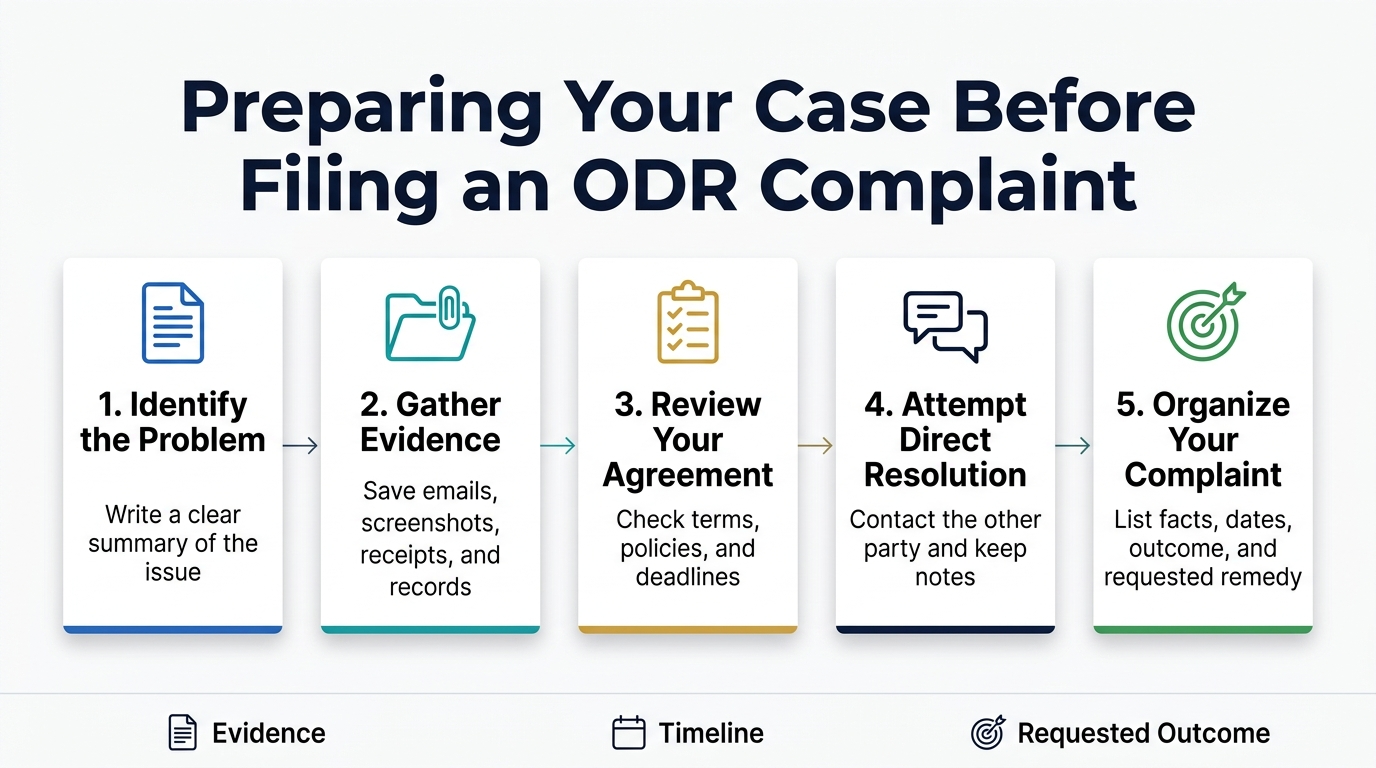
Before you file an ODR complaint, the strength of your case depends almost entirely on the quality of your documentation. Insurers operate with well-organized legal and claims teams, so approaching the online dispute resolution process without a solid evidence base puts you at an immediate disadvantage. Think of this stage as building the foundation of your argument — every document you gather is a brick that makes your case more resistant to challenge.
Here is a structured breakdown of the essential documents you should collect before filing:
Core Documents to Gather
| Document Type | Purpose in Your Case |
|---|---|
| Original insurance policy | Confirms coverage terms, exclusions, and obligations |
| Claim denial letter | Identifies the insurer’s stated reason for rejection |
| All correspondence with the insurer | Demonstrates communication history and any verbal or written commitments |
| Medical records or repair estimates | Provides third-party validation of the claim value |
| Photos, videos, or physical evidence | Supports the factual basis of the loss or damage |
| Police or incident reports | Establishes official record of the event triggering the claim |
| Expert assessments or appraisals | Offers independent professional corroboration |
| Payment history and premium receipts | Confirms the policy was active and in good standing at the time of the claim |
Do not underestimate the importance of the denial letter. This document is the starting point for your entire ODR complaint filing strategy. It tells you exactly what argument the insurer has made against you, which means it also tells you exactly what you need to refute.
Organizing Your Evidence Effectively
Gathering documents is only the first step. How you organize them matters just as much, especially in an online dispute resolution environment where the adjudicator or mediator may be reviewing submissions digitally.
- Create a chronological timeline of all events: from the date of the incident, to when you filed the claim, to when you received the denial, and every interaction in between.
- Label each document clearly with a reference number, date, and a short description of its relevance.
- Make digital copies of all physical documents, ensuring they are clearly legible and properly formatted for upload.
- Back up everything on at least two separate storage platforms — losing key evidence mid-process can be devastating to your case.
The discipline you bring to this organizational stage will directly impact how confidently you can present your case during the ODR hearing and negotiation stage, which we will cover in detail later in this guide.
Reviewing Your Policy Terms and Conditions
One of the most common mistakes people make when fighting an insurance denial is assuming they already understand what their policy covers. In reality, insurance policies are dense legal documents filled with specific language, exclusions, conditions precedent, and definitions that can significantly affect whether a claim is valid. Before you file an ODR complaint, you need to know your policy as thoroughly as the insurer’s team does.
Reading with a Purpose
When reviewing your policy ahead of the insurance dispute resolution process, you are not reading for a general sense of coverage. You are reading with a specific goal: to find the language that supports your claim and to identify any provisions the insurer may have misapplied or misinterpreted in denying it.
Focus your review on the following areas:
- Declarations page — This outlines your coverage limits, policy period, named insureds, and the specific perils or protections included.
- Coverage sections — These define what events, losses, or damages the policy is designed to protect against. Compare these directly against the circumstances of your claim.
- Exclusions section — Insurers frequently cite exclusions as the basis for denial. Read each exclusion carefully to determine whether it genuinely applies to your situation or whether the insurer has interpreted it too broadly.
- Definitions section — Many disputes hinge on how specific terms are defined within the policy itself. A word like “sudden,” “accidental,” or “occurrence” may carry a technical meaning under your policy that differs from its everyday usage.
- Conditions section — This details your obligations as a policyholder, such as timely reporting of claims, cooperation with investigations, and proof of loss requirements. If you fulfilled all conditions and the insurer still denied your claim, this strengthens your appeal.
- Endorsements and riders — These are modifications or additions to the base policy. They can expand or restrict coverage and are frequently overlooked by claimants.
Creating a Side-by-Side Comparison
A practical technique when preparing to appeal an insurer decision is to create a side-by-side comparison between what your policy says and what the insurer claims it says. This approach is particularly useful in an ODR setting where you need to present your arguments clearly and concisely to a third-party decision-maker.
| Policy Language | Insurer’s Interpretation | Your Counterargument |
|---|---|---|
| “Accidental damage” | Claims the damage was foreseeable | Policy does not exclude foreseeable events; it covers accidental ones |
| “Written notice within 30 days” | Claims you failed to provide timely notice | Provide evidence that notice was submitted on day 22 |
| Exclusion for “wear and tear” | Claims the damage falls under this exclusion | Provide expert report showing the damage was sudden, not gradual |
This kind of structured comparison is not just useful for your own understanding — it becomes a compelling presentation tool during the ODR complaint filing and hearing stages.
When to Seek Professional Assistance
If the policy language is particularly complex, or if the financial stakes of your claim are high, this is the point where consulting a professional — such as a public adjuster, insurance attorney, or consumer advocacy organization — can make a meaningful difference. They can identify policy language nuances that a layperson might miss and help you frame your dispute in the most effective terms for the online dispute resolution insurance process.
Identifying the Specific Grounds for Your Dispute
With your evidence gathered and your policy thoroughly reviewed, the next critical step is to articulate precisely why the insurer’s decision to deny your claim is wrong. Vague complaints rarely succeed in dispute resolution processes. The more specific and legally grounded your grounds for dispute, the more seriously your ODR complaint will be taken.
Common Grounds for Disputing an Insurance Claim Denial
Understanding what category your dispute falls into is essential for how to fight an insurance denial effectively. Below are the most common grounds on which claimants challenge insurer decisions:
- Misinterpretation of policy language — The insurer has applied an exclusion or condition in a way that is not supported by the plain reading of the policy text.
- Failure to investigate adequately — The insurer made its decision without conducting a reasonable and thorough investigation into the facts of the claim.
- Application of incorrect exclusion — The insurer cited an exclusion that simply does not apply to the specific circumstances of the loss.
- Valuation disputes — The insurer agrees there is a covered loss but has significantly undervalued the claim amount.
- Bad faith conduct — The insurer acted improperly by unreasonably delaying, undervaluing, or denying the claim without legitimate justification.
- Failure to honor policy obligations — The insurer did not fulfill its own obligations under the policy, such as timely acknowledgment or proper claims handling procedures.
- Procedural errors — The insurer’s internal claims process contained errors that affected the outcome of the decision.
Matching Your Grounds to Your Evidence
Once you have identified the grounds for your dispute, the next step is to match each ground directly to the evidence you have gathered. This creates a logical, defensible structure for your ODR complaint filing. Think of it as connecting the dots for the mediator or adjudicator who will be reviewing your case.
For example:
-
Ground: Misinterpretation of policy exclusion
- Supporting evidence: Copy of the policy exclusion clause + expert report confirming the damage characteristics do not meet the exclusion’s definition
-
Ground: Inadequate investigation
- Supporting evidence: Timeline showing no site inspection was conducted + denial letter issued within 48 hours of claim submission
-
Ground: Valuation dispute
- Supporting evidence: Three independent repair estimates all significantly exceeding the insurer’s offered settlement amount
Prioritizing Your Strongest Arguments
Not all grounds are equally strong, and attempting to argue too many points can dilute the effectiveness of your ODR complaint. With this in mind, next, focus on identifying your one or two most compelling arguments and leading with those.
Ask yourself:
- Which ground is most clearly supported by my documentation?
- Which ground most directly contradicts the insurer’s stated reason for denial?
- Which ground would be most difficult for the insurer to defend against?
The answers to these questions will help you prioritize your case strategy before moving into the formal filing stage.
Framing Your Dispute Clearly
One final but critical consideration at this stage is how you frame your dispute in writing. ODR platforms typically require you to submit a written summary of your complaint, and the clarity and persuasiveness of this summary can influence how the process unfolds.
When framing your dispute:
- Be factual and specific, not emotional. Stick to what the policy says and what the evidence shows.
- Reference policy sections directly using page numbers and clause references where possible.
- State clearly what outcome you are seeking — whether that is full payment of the claim, a revised settlement figure, or a formal review of the denial decision.
- Avoid inflammatory language about the insurer. ODR processes are designed to be neutral, and professional language reinforces your credibility.
Step-by-Step Guide to Filing an ODR Complaint
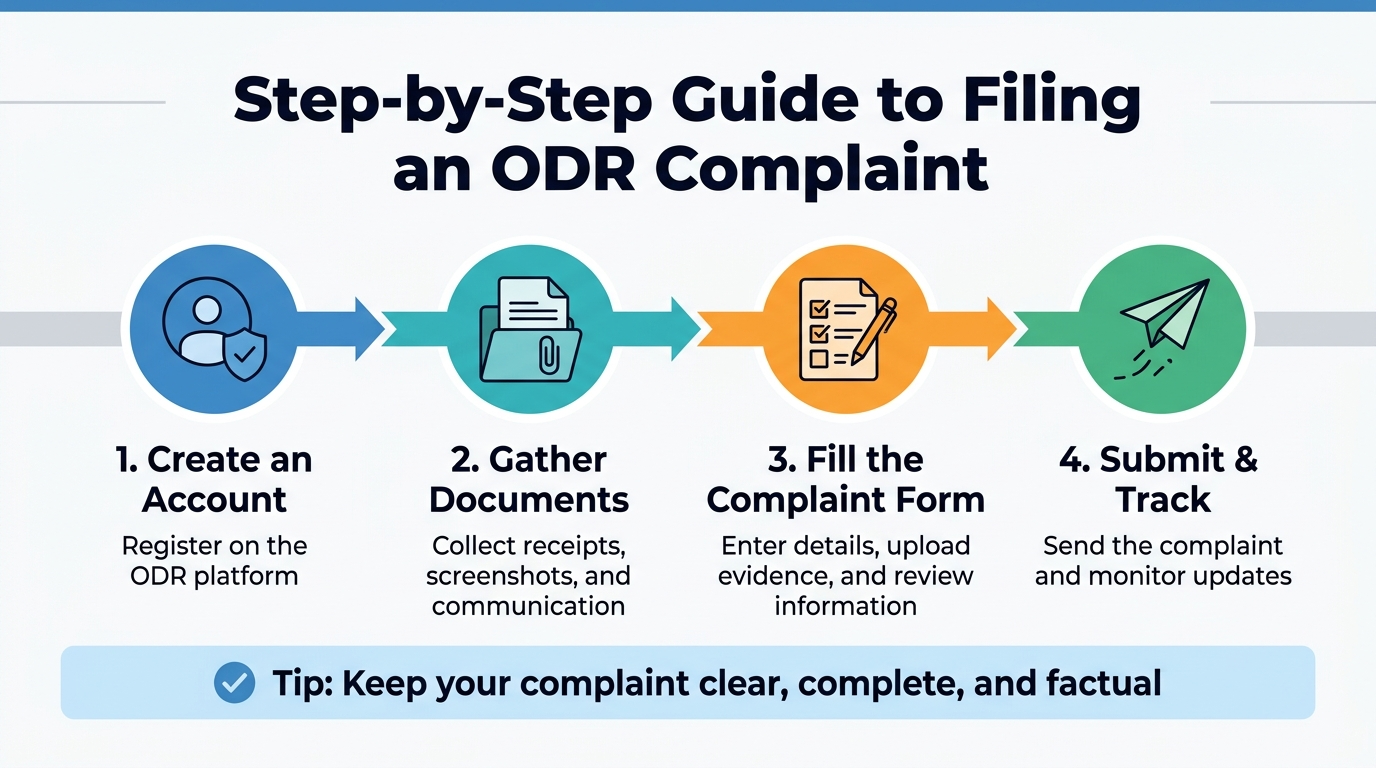
Choosing the Right ODR Platform or Authority
Now that we have covered how to prepare your case before filing, the next critical decision you face is selecting the appropriate ODR platform or authority for your specific insurance dispute. This choice can significantly influence the outcome of your complaint, so it deserves careful consideration.
Different jurisdictions and insurance types have different governing bodies and approved ODR platforms. Understanding which one applies to your situation is the foundation of a successful filing.
Types of ODR Platforms for Insurance Disputes
Not all ODR platforms handle insurance disputes the same way. Broadly, you will encounter three types:
-
Regulatory or Government-Mandated Platforms: These are operated by or affiliated with state insurance commissioners, financial ombudsman offices, or consumer protection agencies. They carry regulatory authority, meaning insurers are typically obligated to participate and comply with outcomes.
-
Industry-Operated Platforms: Some insurance associations run their own dispute resolution portals. While these can be efficient, their neutrality may be more limited compared to government-backed alternatives.
-
Independent ODR Providers: These are third-party platforms that offer mediation or arbitration services. They are useful when both parties agree to resolve a dispute outside of regulatory channels.
Key Factors to Consider When Choosing a Platform
When evaluating which platform to use for your online dispute resolution insurance complaint, weigh the following factors:
| Factor | Why It Matters |
|---|---|
| Jurisdiction coverage | The platform must have authority over your insurer’s operating region |
| Type of insurance dispute | Health, auto, property, and life insurance may have separate designated bodies |
| Binding vs. non-binding outcomes | Binding arbitration decisions are legally enforceable; mediation outcomes may not be |
| Cost to file | Some platforms are free to consumers; others may charge administrative fees |
| Turnaround time | Regulatory platforms may have mandated response timelines |
| Language and accessibility | Ensure the platform supports your preferred language and format |
Verifying the Platform’s Legitimacy
Before submitting any documentation, confirm that the platform you have selected is officially recognized. You can do this by:
- Checking your insurance policy documents for any dispute resolution clauses that name a specific ODR body or arbitration provider
- Visiting your state or national insurance regulatory authority’s official website to see their list of approved or affiliated ODR providers
- Contacting the insurer’s complaint department directly to ask which ODR forums they are registered with or obligated to participate in
Choosing the wrong platform is one of the most avoidable mistakes in the insurance dispute resolution process. It can result in your complaint being dismissed on procedural grounds, wasting valuable time and potentially missing critical deadlines.
Submitting Your Complaint Correctly and Completely
With the right ODR platform identified, the next phase is the actual submission of your complaint. This is where many claimants inadvertently weaken their cases by filing incomplete, unclear, or poorly organized complaints. A well-constructed complaint does not just state that you disagree with the insurer’s decision — it builds a logical, evidence-backed argument that demands a response.
Understanding What a Complete Complaint Includes
When filing an ODR complaint, most platforms will require you to provide the following core components:
- Personal and Policy Information: Your full name, contact details, policy number, and the insurer’s name and contact information. Make sure these match exactly what appears on your policy documents.
- Detailed Description of the Dispute: A clear, factual narrative of what happened — when you filed the original claim, what the insurer’s response was, and specifically how their decision failed to align with your policy terms or applicable law.
- Evidence and Supporting Documentation: Copies of your policy, the denial letter, your original claim submission, correspondence with the insurer, photos, medical records, repair estimates, expert opinions, or any other relevant material.
- Statement of the Remedy You Seek: Be explicit about what you want — whether that is full payment of a denied claim, partial payment, reconsideration of a specific coverage clause, or another specific outcome.
- Prior Complaint History: Most platforms require you to demonstrate that you have already exhausted the insurer’s internal appeals process before escalating to ODR. Include documentation of any prior appeals and their outcomes.
Writing Your Complaint Narrative Effectively
The narrative section of your complaint is arguably the most important element. This is where you make your case in your own words, and it should be crafted with precision. Follow these principles:
- Be chronological and factual: Start from when you purchased the policy, move through the incident that prompted the claim, and trace every step of the insurer’s handling of your case. Avoid emotional language; facts are your most powerful tool.
- Reference specific policy language: When arguing that the denial was unjustified, quote directly from your policy. If your insurer denied your claim citing an exclusion, address that exclusion explicitly and explain why it should not apply to your situation.
- Avoid unnecessary length: A concise, well-organized complaint is more persuasive than a lengthy, rambling one. If the platform has a word or page limit, respect it — and if it does not, still aim for clarity over volume.
- Use plain, professional language: Write as though you are addressing an educated, neutral third party who has no prior knowledge of your case. Avoid jargon unless it is defined, and avoid colloquialisms.
Organizing and Presenting Your Evidence
Supporting documents can make or break your insurance claim appeal. Here is how to handle them effectively:
- Label every document clearly: Use a numbering or lettering system (e.g., Exhibit A, Exhibit B) and reference these labels in your complaint narrative so the reviewer can cross-check without confusion.
- Include only what is directly relevant: Submitting excessive or tangential documents can dilute your strongest evidence and burden the reviewer unnecessarily.
- Provide originals or certified copies where required: Some platforms will not accept photocopies or screenshots of critical documents like policy contracts or denial letters. Check the platform’s guidelines carefully.
- Redact sensitive personal information where appropriate: If your documents contain third-party personal information that is not directly relevant to the dispute (such as medical information about a family member not central to the claim), redact it appropriately while preserving the relevant content.
Double-Checking Before You Submit
Before clicking submit or mailing your complaint, run through this final checklist:
- All required fields in the complaint form are completed
- Personal and policy details are accurate and match source documents
- The dispute narrative is clear, chronological, and references specific policy language
- All referenced exhibits are attached and properly labeled
- Evidence of prior internal appeal is included
- The remedy you are seeking is clearly stated
- The complaint is within any page or word limits set by the platform
- You have retained a complete copy of everything you are submitting
Meeting Deadlines and Avoiding Common Filing Mistakes
Previously, we have discussed how to choose the right platform and structure a complete complaint. With this in mind, next, we’ll see why timing and procedural precision are just as important as the substance of your complaint. Even a compelling, well-documented case can be dismissed if it falls foul of filing deadlines or procedural requirements.
Why Deadlines Are Non-Negotiable in the ODR Process
In the insurance dispute resolution process, deadlines exist at multiple stages, and missing even one can be fatal to your complaint. There are typically three layers of deadlines to track:
-
Internal Appeals Deadlines: Before you can escalate to ODR, most regulatory frameworks require you to have filed an internal appeal with your insurer within a specified timeframe after receiving the denial — often 30 to 180 days depending on the jurisdiction and type of insurance. If you missed this deadline without a valid reason, your access to ODR may be restricted.
-
ODR Filing Deadlines: After exhausting internal appeals, there is typically a window within which you must file your ODR complaint. This can range from 30 days to several years depending on local statutes of limitation and the type of dispute. Know this deadline before you begin preparing your complaint.
-
Response Deadlines During the ODR Process: Once your complaint is accepted and the process begins, you will likely face deadlines for submitting additional evidence, responding to the insurer’s rebuttal, and attending hearings. Missing these intermediate deadlines can result in your complaint being decided without your input — almost always to your disadvantage.
How to Track and Manage Deadlines
Managing multiple deadlines across a complex dispute process requires a proactive system. Consider the following approach:
- Create a dispute timeline document: Record every date — when the incident occurred, when you filed the original claim, when you received the denial, when you filed the internal appeal, when that appeal was denied, and when you filed the ODR complaint. This document serves both as an organizational tool and as evidence of your procedural compliance.
- Set calendar reminders with buffer time: For every deadline, set a reminder at least five to seven business days in advance. This gives you time to address any unexpected complications — a missing document, a technical issue with the platform, or a clarification needed from a witness.
- Confirm receipt of your filing: Whether submitting electronically or by post, always confirm that your complaint was received by the platform within the required timeframe. Request an acknowledgment email, retain proof of postage, or screenshot your submission confirmation.
The Most Common Filing Mistakes to Avoid
Understanding what commonly goes wrong in the ODR complaint filing process helps you sidestep these pitfalls entirely. Here are the most frequent errors that derail otherwise valid complaints:
1. Filing Before Exhausting Internal Remedies
Most ODR platforms will not accept a complaint unless you have first gone through the insurer’s formal internal appeals process. Jumping straight to ODR without this step leads to an automatic rejection. Always document your internal appeal and its outcome before filing externally.
2. Submitting an Incomplete Complaint
Missing fields, absent exhibits, or a vague description of the dispute are among the most common reasons complaints are returned or dismissed at the preliminary stage. The ODR reviewer cannot advocate for what they do not know. Fill in every section, attach every required document, and be explicit about what you are asking for.
3. Failing to Identify the Correct Respondent
Your complaint must name the correct legal entity — not just a generic reference to “the insurance company.” Use the insurer’s full registered name as it appears on your policy. If you name the wrong entity, processing can be delayed significantly while the platform works to identify the correct respondent.
4. Using the Wrong Platform
As discussed, filing with an ODR platform that lacks jurisdiction over your insurer or your type of dispute is a critical error. If the platform lacks authority, your complaint will simply be redirected or dismissed. Verify jurisdiction before you invest time in preparing your submission.
5. Omitting Evidence of Prior Communication
The ODR reviewer needs to see that you made a genuine attempt to resolve the dispute directly with the insurer. Without records of your communications — emails, letters, call logs — your complaint may lack the foundation it needs to proceed.
6. Emotional or Aggressive Language in the Complaint
It is natural to feel frustrated when dealing with an insurance claim denial, but expressing that frustration in your complaint undermines your credibility. Keep your tone professional and objective throughout. Complaints that read as aggressive or emotionally charged can predispose reviewers negatively before they even reach your core argument.
7. Requesting an Unrealistic Remedy
Be precise and reasonable in what you are asking for. Asking for compensation that far exceeds your documented losses, or requesting remedies outside the scope of what the ODR platform can award, signals a lack of understanding of the process and can weaken your overall credibility.
8. Neglecting to Keep Copies of Everything
This seems basic, but it is frequently overlooked. Always retain a complete copy of your complaint, all attached exhibits, and any correspondence with the ODR platform. If there is ever a dispute about what you submitted or when, your copies are your proof.
Special Considerations for Electronic Filings
The majority of modern ODR platforms operate primarily online, which introduces a set of practical considerations:
- File format requirements: Check whether the platform accepts PDFs, Word documents, or specific image formats. Submitting documents in an unsupported format can cause technical failures that delay or invalidate your submission.
- File size limits: Large exhibits like high-resolution photos or lengthy medical records may exceed upload limits. Compress files where possible without sacrificing legibility, or ask the platform whether physical copies can supplement your digital submission.
- Secure internet connections: Submit your complaint from a secure, private internet connection. Avoid public Wi-Fi networks when uploading sensitive personal and financial documents.
- Time zone considerations: If you are filing close to a deadline, be aware of which time zone the platform’s deadline is set in. A submission at 11:58 PM in your local time may be after the deadline if the platform operates on a different time zone.
- Technical failures: If you experience a technical issue during submission — a platform crash, an upload error, or a payment failure for any filing fee — document it immediately with screenshots and contact the platform’s support team. Some platforms make provisions for deadline extensions in cases of documented technical failures, but you must act promptly.
Building in a Buffer: The 80% Rule
Experienced practitioners in dispute resolution often operate by what might be called the “80% rule” — aim to have your complaint fully prepared when you are 80% of the way through the available filing window. This provides a meaningful buffer for unexpected complications without cutting it dangerously close to the deadline.
The step-by-step ODR guide framework is only as effective as the discipline you bring to executing it within the required timeframes. No amount of strong evidence or compelling argument can compensate for a complaint filed a day too late.
Navigating the ODR Hearing and Negotiation Stage
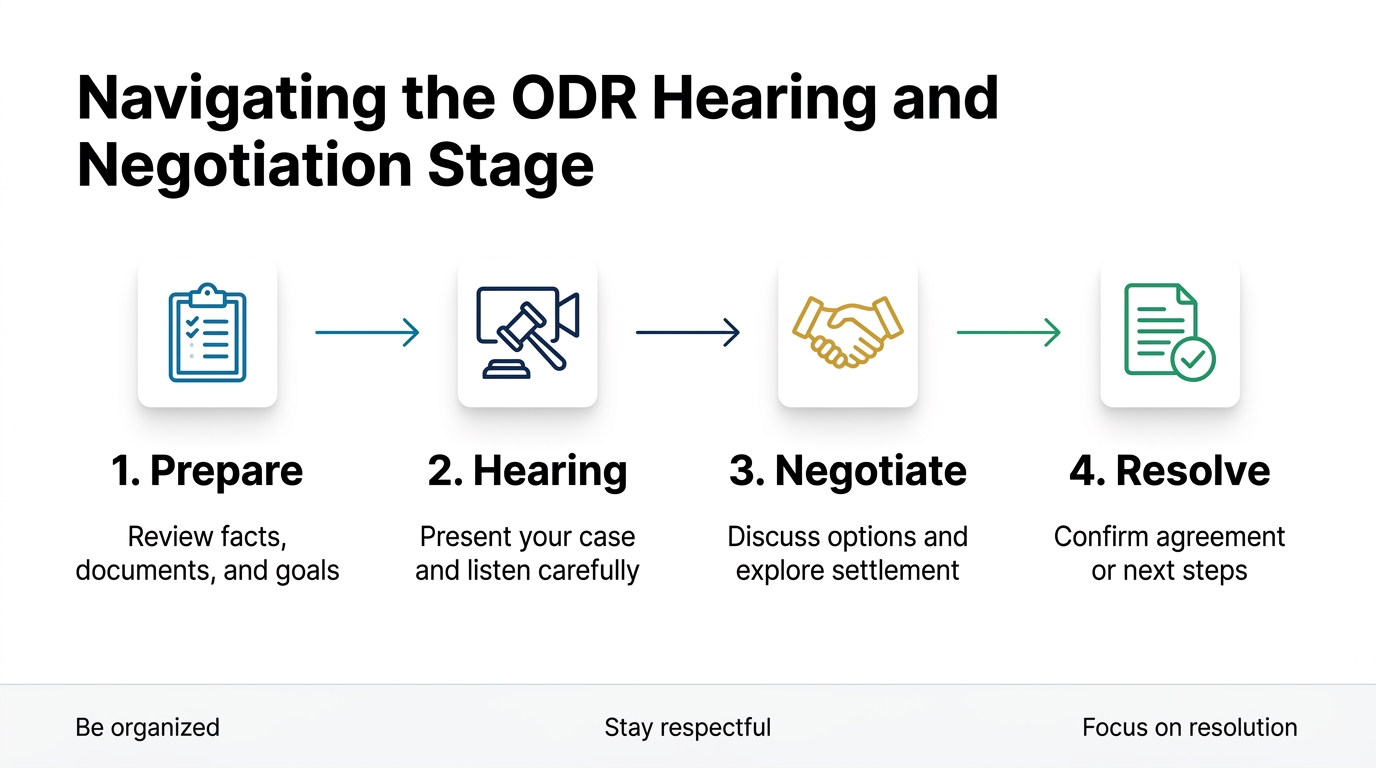
What to Expect During the Review Process
Once your complaint is received and acknowledged by the ODR platform or designated neutral body, the review process typically unfolds in several distinct phases:
Phase 1: Case Assignment and Initial Review
After submission, your case is assigned to a neutral third party — this could be a mediator, arbitrator, or case reviewer depending on the specific ODR platform and your jurisdiction. This individual will:
- Review all submitted documentation from both parties
- Verify that the complaint meets procedural requirements
- Confirm that the dispute falls within the scope of the ODR process
- Set a timeline for proceedings and communicate it to both parties
During this phase, expect to receive formal acknowledgment of your case number and contact details for your assigned neutral. Response windows can vary, but most platforms operate within defined timeframes — often 30 to 90 days from submission to resolution.
Phase 2: Information Exchange
Both you and the insurer will be given the opportunity to submit written statements, supporting evidence, and responses to each other’s claims. This is known as the discovery or information exchange phase. Key things to expect here include:
- Document requests: The neutral party may ask for additional documents to clarify facts
- Written submissions: Each side submits a formal written argument outlining their position
- Rebuttal windows: After reviewing the insurer’s submission, you may be given a specific timeframe to respond
This back-and-forth is a core feature of online dispute resolution for insurance claims and is designed to ensure both parties have a fair opportunity to present their case before any decision is made.
Phase 3: Scheduled Hearing or Negotiation Session
Depending on the format chosen — mediation, arbitration, or negotiated settlement — you will either participate in a live virtual session (via video conferencing) or communicate asynchronously through the platform’s secure messaging system.
| Format | Structure | Outcome |
|---|---|---|
| Mediation | Facilitated negotiation between both parties | Mutually agreed settlement |
| Arbitration | Formal hearing with evidence review | Binding or non-binding decision by arbitrator |
| Negotiated Settlement | Direct back-and-forth with insurer | Agreed resolution without formal hearing |
Understanding which format your dispute falls under helps you mentally and strategically prepare for what comes next.
How to Present Your Case Effectively
With this in mind, next, we will look at how to present your case in the most compelling and organized manner during the ODR hearing negotiation stage. Even in an online environment, the quality of how you communicate your argument can be the deciding factor between a denied and an approved claim.
Lead with the Facts, Not Emotions
It is entirely natural to feel frustrated or wronged when facing an insurance claim denial, but the ODR process is analytical and evidence-driven. Neutral parties and mediators respond to logic, documentation, and factual accuracy — not emotional appeals. Structure your argument around:
- What the policy states: Quote specific clauses, section numbers, and exact policy language
- What the insurer said: Reference the denial letter verbatim where relevant
- What the evidence shows: Connect your documents directly to the claim and policy language
Structure Your Argument Clearly
A well-organized presentation makes it easier for the neutral party to follow your reasoning and harder for the insurer to poke holes in your case. Consider using the following structure:
- Opening statement: Briefly summarize the nature of the dispute and what outcome you are seeking
- Policy interpretation: Explain how the policy language supports your claim
- Timeline of events: Present a clear chronological account of the incident, claim submission, and denial
- Evidence review: Walk through each piece of supporting evidence and explain its relevance
- Conclusion: Restate what you are asking for and why you believe the denial should be overturned
Use Supporting Documents Strategically
Previously, in the preparation stage, you would have gathered all necessary documentation. During the hearing, how you use those documents matters just as much as having them. Keep the following in mind:
- Reference documents by name and date: Rather than vaguely pointing to “the report,” say “the independent adjuster’s report dated March 14th”
- Highlight key passages: If submitting written documents, use annotations or clearly marked highlights to draw attention to critical language
- Submit organized exhibits: Number and label every piece of evidence so the neutral party can follow your references without confusion
Maintain Professional Communication
Whether your ODR hearing is conducted through live video or asynchronous messaging, maintaining a professional and respectful tone reinforces your credibility. Avoid:
- Using accusatory or inflammatory language toward the insurer
- Interrupting the neutral party or opposing representative during live sessions
- Submitting last-minute evidence that the other party has not had a chance to review
Instead, be concise, calm, and consistent. Your goal is to demonstrate that your position is grounded in fact and policy language — and that you are a reasonable party seeking a fair resolution.
Leverage the Neutral Party’s Role
During mediation especially, the neutral facilitator is there to help both parties find common ground. Do not treat the mediator as an opponent. Instead:
- Ask clarifying questions if you do not understand a point being made
- Request the mediator’s guidance on procedural matters if you feel the process is becoming one-sided
- Be open to discussion while staying firm on your core position
Understanding how to work with the neutral rather than against the process is a critical skill when appealing an insurer decision through ODR.
Responding to the Insurer’s Counterarguments
One of the most challenging aspects of the insurance dispute resolution process is effectively countering the insurer’s pushback. Insurers are experienced in defending claim denials and will typically come to the ODR hearing well-prepared. Knowing how to respond strategically is essential to fighting an insurance denial effectively.
Anticipate Common Insurer Arguments
Before the hearing or negotiation session, take time to think through the arguments the insurer is likely to raise. Common counterarguments include:
- Policy exclusions: The insurer may argue that the incident falls under a listed exclusion in the policy
- Lack of documentation: They may claim the evidence you provided is insufficient or unverifiable
- Untimely filing: The insurer might argue that you failed to report the claim within the required timeframe
- Pre-existing conditions or prior damage: Particularly in property or health insurance, the insurer may claim that the damage or condition existed before coverage began
- Misrepresentation: In some cases, insurers allege that information provided at the time of policy issuance was inaccurate
By thinking through these possibilities in advance, you can prepare targeted responses and pre-emptively address them in your initial submission.
Address Exclusions with Precision
If the insurer invokes a policy exclusion, do not simply accept their interpretation. Instead:
- Read the exclusion clause carefully and look for ambiguous language — under many insurance regulations, ambiguities in policy language are interpreted in favor of the policyholder
- Check whether the exclusion was clearly communicated to you at the time of policy purchase
- Determine whether the specific circumstances of your claim actually fall within the scope of the exclusion as written, rather than the insurer’s broad interpretation of it
For example, if an insurer claims water damage is excluded, but your policy language specifically covers “sudden and accidental discharge,” you have a strong basis to argue the exclusion does not apply.
Counter Documentation Challenges
If the insurer argues that your evidence is insufficient, respond by:
- Providing additional corroborating documents if available — such as a second professional opinion or additional photographs
- Challenging the insurer’s own documentation, if it appears incomplete or selectively presented
- Requesting that the neutral party ask the insurer to provide the specific documentation or standard they used to assess your claim
Remember, the burden of proof in an ODR setting is generally balanced — the insurer must also justify their denial with evidence, not just assertion.
Rebut Timeliness Arguments
If the insurer claims late filing, respond by:
- Providing timestamps, emails, or written records that confirm when you submitted your claim
- Referencing policy language that specifies the exact notification window — vague timeliness language is often interpreted broadly in favor of the insured
- Explaining any legitimate delays (such as hospitalization or natural disaster) that may qualify as extenuating circumstances under your policy’s terms
Handle Misrepresentation Claims Carefully
Misrepresentation allegations are among the most serious counterarguments an insurer can raise. If this comes up during your ODR hearing:
- Stay calm and do not become defensive in a way that undermines your credibility
- Ask the insurer to specify exactly what information they believe was misrepresented and how it materially affected their risk assessment
- Provide documentation that supports the accuracy of what you originally stated — such as medical records, property inspection reports, or prior correspondence
If the alleged misrepresentation is minor and unrelated to the actual claim, make that point clearly and calmly.
Use the Neutral Party as a Check
During live sessions, if the insurer’s counterarguments appear procedurally improper — such as introducing new evidence without prior notice or making claims that fall outside the scope of the original denial letter — you have the right to raise this with the neutral party. For example:
- “I would like to note for the record that this argument was not included in the original denial letter and represents a new basis for denial that I have not had the opportunity to address.”
This type of objection, delivered professionally, can signal to the neutral party that the insurer is shifting its position — which can itself be a point in your favor when resolving insurance disputes online.
Stay Focused on the Core Issue
It is easy to get drawn into side arguments during a contentious hearing. The insurer may attempt to redirect attention toward peripheral issues to obscure the central weakness in their denial. Keep the discussion anchored by:
- Regularly returning to the specific policy language that supports your claim
- Summarizing your core argument at key moments in the discussion
- Politely declining to engage on issues that are not directly relevant to the denial being disputed
Know When to Negotiate
Not every ODR case needs to be fought to a definitive ruling. If the insurer presents a settlement offer during the negotiation stage, evaluate it carefully against:
- The full value of your original claim
- The time and effort required to continue through arbitration
- The likelihood of achieving a better outcome through a formal ruling
- Whether the offer addresses the core harm you experienced
Sometimes a negotiated partial settlement is a strategically sound outcome — particularly when the cost and duration of continued proceedings outweigh the marginal gain of pursuing a full award. However, do not accept a settlement offer simply because the process feels overwhelming. The structure of ODR is specifically designed to make appealing insurer decisions accessible and manageable, even for individuals without legal representation.
Understanding when to hold firm and when to negotiate is as important as any other skill in the ODR complaint filing and hearing process. Approach every stage with clarity about your priorities, a firm grasp of your documentation, and a consistent, professional demeanor — and you will be in the strongest possible position to achieve a fair resolution.
Achieving a Favorable Outcome Through ODR
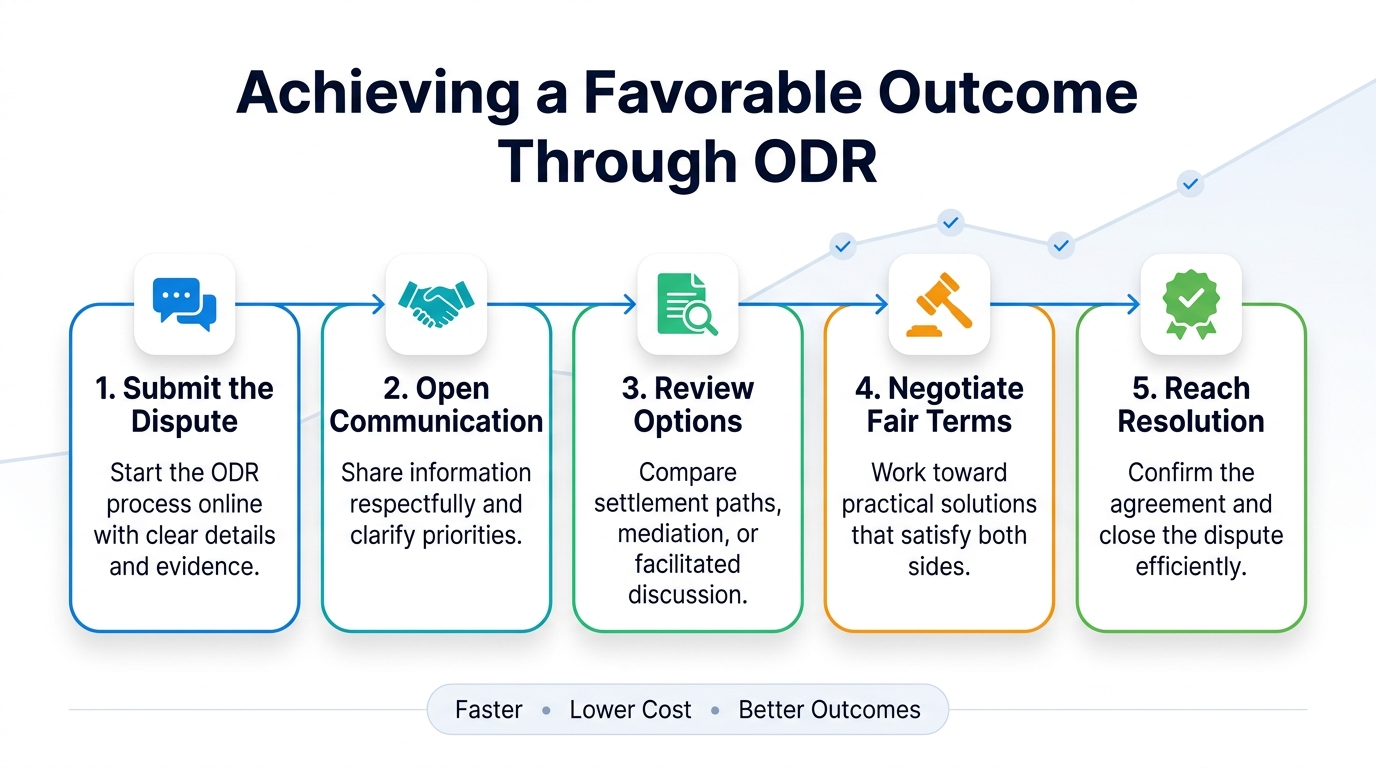
Understanding the Types of Resolutions Available
Now that we have covered the negotiation and hearing stages of the ODR process, it is important to understand what outcomes you can realistically expect once the process concludes. Not every ODR case ends the same way, and knowing the types of resolutions available helps you evaluate whether the outcome truly serves your interests before you accept or reject it.
ODR proceedings in insurance disputes typically conclude in one of the following ways:
Binding Decisions
A binding decision means both parties — you and the insurer — are legally obligated to comply with the outcome. In many regulated ODR frameworks, particularly those administered through government-backed or insurance ombudsman bodies, decisions above a certain threshold or within specific categories carry legal enforceability. This is one of the most favorable outcomes you can achieve through the online dispute resolution insurance process, as it removes ambiguity about whether the insurer must pay.
If the decision is ruled in your favor:
- The insurer may be ordered to pay the full claimed amount
- The insurer may be directed to pay a partial settlement reflecting the legitimate portion of your claim
- The insurer may be required to reinstate a lapsed policy or correct a wrongful cancellation
- Interest or compensation for delays may also be awarded in some jurisdictions
Non-Binding Recommendations
Some ODR platforms, especially those functioning as neutral mediation services rather than quasi-judicial bodies, issue non-binding recommendations. These are essentially guided suggestions that both parties are encouraged — but not compelled — to follow.
While this may seem like a weaker outcome, non-binding recommendations still carry significant weight. Insurers are often reluctant to publicly disregard the findings of a neutral ODR body, as it can damage their regulatory standing and reputation. In practice, a well-reasoned recommendation in your favor often results in the insurer complying voluntarily.
Negotiated Settlements
During the ODR hearing and negotiation stage, many disputes are resolved through a mutually agreed settlement before any formal decision is issued. A negotiated settlement means:
- You agree to accept a specific amount or corrective action
- The insurer agrees to fulfill that obligation
- Both parties formally record the agreement through the ODR platform
Negotiated settlements tend to be faster and provide more certainty than waiting for a formal ruling. However, it is critical to evaluate whether the settlement genuinely compensates you for your insurance claim denial before signing off. Accepting a settlement typically waives your right to pursue the matter further on the same grounds.
Dismissal or Partial Relief
In some cases, the ODR body may find that the insurer’s denial was partly justified, resulting in partial relief — where you recover some but not all of what you claimed. Alternatively, your complaint may be dismissed if the evidence does not support your position sufficiently.
Understanding this range of outcomes in advance helps you approach the ODR complaint filing process with realistic expectations and a clearer strategy for what you are willing to accept.
Enforcing the Decision If the Insurer Still Refuses
With this in mind, let us address one of the most frustrating scenarios a claimant can face: reaching a favorable outcome through the online dispute resolution process, only to have the insurer refuse to comply. While this is not common, it does happen — and knowing how to enforce the decision is just as important as winning it.
Review the Legal Status of the Decision First
Before taking any enforcement action, confirm whether the ODR decision is legally binding in your jurisdiction. This is crucial because:
- Binding decisions from regulated bodies (such as insurance ombudsman offices or government-recognized arbitration panels) typically carry legal enforceability similar to a court order
- Non-binding recommendations require additional steps to enforce if the insurer refuses to comply voluntarily
Check the documentation issued by the ODR platform carefully. It should explicitly state the nature of the decision, any compliance deadlines imposed on the insurer, and the consequences of non-compliance.
Document the Non-Compliance
If the insurer fails to act within the stipulated deadline, your first step is to create a clear record of non-compliance. This includes:
- Saving all ODR platform communications and the formal decision document
- Sending a written notice to the insurer referencing the ODR ruling and demanding compliance by a specific date
- Keeping copies of all correspondence, including emails, letters, and any acknowledgments from the insurer
This documentation will be essential if you need to escalate the matter to legal or regulatory authorities.
File a Non-Compliance Report with the ODR Body
Most established ODR platforms and ombudsman offices have a formal mechanism for reporting non-compliance. Filing such a report serves multiple purposes:
- It places the insurer on official record as having refused to honor a legitimate ruling
- It may trigger regulatory penalties or sanctions against the insurer
- It strengthens your position if you choose to escalate to court or a higher authority
When filing the non-compliance report, include:
- The reference number or case ID of your ODR proceeding
- A clear timeline showing the decision date and the insurer’s failure to act
- Copies of your written notices to the insurer
- Any response (or non-response) received from the insurer
Approach the Insurance Regulator Directly
If the ODR body lacks direct enforcement powers, approaching the relevant insurance regulatory authority in your region is your next strongest move. Insurance regulators have the authority to:
- Investigate complaints against licensed insurers
- Impose fines and penalties for non-compliance with dispute resolution rulings
- Mandate corrective actions and monitor follow-through
- In extreme cases, suspend or revoke an insurer’s operating license
Filing a formal complaint with the regulator — backed by your ODR decision and evidence of non-compliance — significantly increases pressure on the insurer to fulfill its obligations. This step is particularly effective in the context of appealing an insurer decision, as regulators take a dim view of insurers who disregard formal rulings.
When to Escalate to Higher Legal Authorities
Situations That Warrant Legal Escalation
Not every unfavorable outcome or enforcement challenge requires court intervention. However, the following situations clearly indicate that escalation beyond ODR is the appropriate course of action:
| Situation | Why Escalation Is Needed |
|---|---|
| The ODR decision is non-binding and the insurer refuses to comply | No legal mechanism exists to force compliance without court involvement |
| The claim amount exceeds the ODR body’s jurisdiction limit | Higher courts or arbitration panels are better equipped to handle large disputes |
| The ODR ruling contains a legal error or procedural violation | Legal appeals can correct decisions that were improperly reached |
| The insurer engages in bad faith conduct beyond the claim denial | Bad faith insurance practices may require civil litigation |
| Regulatory complaints fail to produce action within a reasonable timeframe | Direct legal action may be the only remaining remedy |
Civil Court Litigation
If ODR has not produced an enforceable resolution, filing a civil lawsuit against the insurer is the most direct path to legal enforcement. Depending on the claim amount:
- Small claims court may be appropriate for lower-value disputes and allows you to represent yourself without an attorney in many jurisdictions
- General civil court is suited for higher-value claims and more complex disputes involving policy interpretation, bad faith, or punitive damages
When preparing for civil litigation after an ODR proceeding, your documented record from the ODR process becomes a powerful asset. The ODR decision, correspondence, and evidence you compiled during the insurance dispute resolution process can all be submitted to support your case in court.
Before filing, consider the following:
- Statute of limitations: Confirm the deadline for filing a lawsuit related to your specific type of insurance claim in your jurisdiction
- Legal representation: Consulting an attorney who specializes in insurance disputes is strongly advisable at this stage
- Cost-benefit analysis: Weigh the potential recovery against the cost of litigation, particularly for smaller claim amounts
Insurance Regulatory Escalation
Beyond the ODR body’s own regulatory reporting mechanism, most jurisdictions have a dedicated insurance regulatory authority that operates independently. If you have not already engaged this body during the enforcement phase, doing so at the escalation stage is a strategic move.
Regulatory escalation is particularly appropriate when:
- There is a pattern of wrongful denials by the insurer (not limited to your case)
- The insurer’s conduct suggests systemic bad faith
- The ODR body lacks jurisdiction over a specific aspect of your complaint
Regulatory bodies can investigate matters that go beyond individual claim disputes, and their involvement can sometimes resolve an insurance claim denial faster than court proceedings, especially if the insurer is risk-averse about regulatory scrutiny.
Seeking an Independent Legal Opinion
Before committing to full-scale litigation or a formal regulatory complaint, obtaining an independent legal opinion on the strength of your case is a prudent step. An insurance law specialist can:
- Assess the merits of your claim based on the ODR record and policy documents
- Identify legal grounds for appeal that may not be immediately obvious
- Advise on the most cost-effective escalation path
- Help you understand the likely timeline and realistic outcomes
This step is especially important if the ODR ruling was partially or fully against you, as it helps you determine whether continuing the fight is worthwhile given the evidence and applicable law.
Practical Tips for a Smooth Escalation Process
When moving from ODR to higher legal authorities, the transition can be smoother if you take the following steps proactively:
- Organize your complete documentation: Compile all ODR submissions, hearing records, decisions, correspondence, and enforcement attempts into a single, chronologically ordered file
- Obtain a certified copy of the ODR decision: Courts and regulatory bodies may require official documentation rather than self-printed copies
- Identify the correct legal forum: Different types of insurance disputes (life, health, property, auto) may be governed by different regulatory and legal frameworks
- Act within deadlines: Both legal and regulatory escalation pathways have strict time limits — missing them can permanently forfeit your right to pursue the matter
- Stay professional and factual: At every stage of escalation, focus on documented facts and legal arguments rather than emotional appeals, as this significantly strengthens your credibility
Escalating an insurance claim appeal to higher legal authorities is a serious step, but it is sometimes the only path to achieving the justice you deserve after a wrongful insurance claim denial. The effort you invested in the ODR process — building your case, gathering evidence, and negotiating in good faith — does not go to waste at this stage. Instead, it forms the foundation of a stronger legal challenge.
Tips to Strengthen Your Position in Future Insurance Disputes
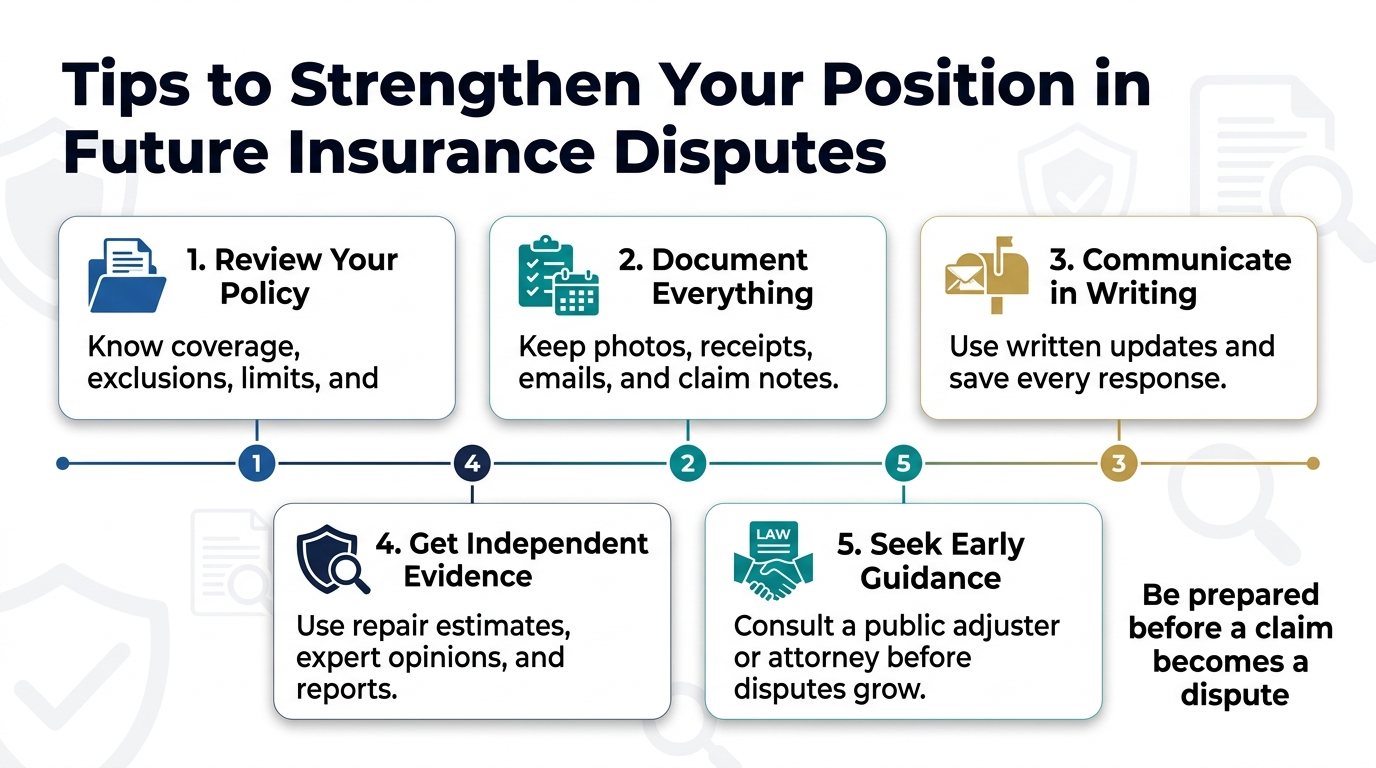
Keeping Thorough Records of All Insurance Communications
Now that we have covered how to achieve a favorable outcome through ODR, it is equally important to think ahead. One of the most powerful things you can do to protect yourself in any future insurance dispute is to build a habit of meticulous record-keeping from the very first interaction with your insurer.
Every email, letter, phone call summary, claim form, and policy document is a potential piece of evidence. When an insurance claim denial occurs, the insurer’s position is almost always backed by their internal documentation. Your ability to counter that position depends entirely on how well you have documented your own side of the story.
What Records You Should Be Keeping
Maintaining thorough records is not just about storing paperwork. It is about creating a clear, chronological trail that demonstrates your actions, communications, and compliance with policy terms. Consider organizing and retaining the following:
- Written correspondence: Save every email, letter, and formal notice exchanged with your insurer. Even routine acknowledgment emails can become significant if a dispute arises over whether you were properly notified of a decision.
- Phone call logs: After every call with your insurer or their representatives, write a brief note documenting the date, time, name of the representative, and key points discussed. This habit can prove invaluable during an insurance dispute resolution process.
- Claim submission records: Keep copies of every claim form you submit, along with confirmation receipts or reference numbers. Never rely on memory or verbal assurances about submission dates.
- Supporting evidence: Photographs, invoices, receipts, medical records, repair estimates, and police reports should all be stored systematically, ideally in both physical and digital formats.
- Insurer’s responses and reasons for denial: If your claim is denied, preserve the denial letter in full. This document outlines the insurer’s stated reasons and is essential when filing an ODR complaint or appealing an insurer decision.
- Policy documents and endorsements: Keep every version of your policy, including amendments, riders, and renewal documents. Policy language evolves, and having the exact version in force at the time of a claim matters.
Best Practices for Organizing Your Records
A disorganized collection of documents is almost as problematic as having no records at all. Structure your record-keeping system so you can retrieve any document quickly when it matters most.
| Record Type | Storage Method | Frequency of Update |
|---|---|---|
| Policy documents | Cloud storage + physical file | At each renewal or amendment |
| Claim correspondence | Dedicated email folder + printed copies | After every interaction |
| Phone call notes | Digital notes app or physical logbook | Immediately after each call |
| Supporting evidence | Labeled folders by claim date | As new evidence is gathered |
| Denial letters | Scanned PDF + original hard copy | Upon receipt |
Adopting a consistent system means that when you need to file an ODR complaint or enter the insurance dispute resolution process, you are not scrambling to piece together a case. Your evidence is already organized, timestamped, and accessible.
Knowing Your Policy Inside Out Before Filing Claims
Previously, I’ve discussed how preparation before filing an ODR complaint can significantly influence the outcome. That same principle applies even before a dispute arises. Understanding your insurance policy thoroughly before you ever need to file a claim is one of the most effective insurance claim appeal tips you can act on.
Many policyholders do not read their insurance documents in detail until something goes wrong. By that point, they are often surprised to discover exclusions, conditions, or obligations they were unaware of — and insurers frequently use those gaps in policyholder knowledge to justify an insurance claim denial.
Breaking Down the Key Components of Your Policy
A typical insurance policy consists of several distinct sections, each serving a different function. Familiarity with each of these puts you in a far stronger position when dealing with any potential dispute.
- Declarations page: This is the summary of your coverage. It lists the insured parties, the coverage period, the types of coverage purchased, and the coverage limits. Verify that all information here is accurate and up to date.
- Insuring agreement: This section describes what the insurer promises to cover. Read it carefully to understand the scope of protection you are actually paying for.
- Exclusions: This is arguably the most critical section to understand. Exclusions define what is not covered under your policy. Insurers often cite exclusions as a basis for denial, so knowing them in advance helps you either seek additional coverage or understand the risks you are accepting.
- Conditions: These outline the obligations you must fulfill to keep your coverage valid and to successfully file a claim. Conditions typically include requirements like timely notification of a loss, cooperation with the insurer’s investigation, and providing accurate information at the time of application.
- Endorsements and riders: These are modifications to the standard policy. They can either expand or restrict coverage. Never assume your base policy reflects your full coverage without checking for endorsements.
- Definitions section: Insurance policies use specific defined terms. A word like “occurrence,” “accident,” or “property” may have a very different meaning within the policy than it does in everyday language. Understanding these definitions prevents costly misunderstandings.
Practical Steps to Strengthen Your Policy Knowledge
Knowing your policy is not a one-time activity. Insurance products change at renewal, and your personal circumstances change over time as well. Build the following practices into your routine:
- Read the full policy document upon purchase or renewal. Take notes on sections that are unclear and seek clarification in writing from your insurer.
- Request written clarification on ambiguous terms. If a clause seems unclear, ask your insurer to explain it in writing. That written response becomes part of your record and can support your position if you need to fight an insurance denial later.
- Review your coverage annually. Major life events — a home renovation, a new vehicle, a change in occupation — can affect whether your existing coverage is adequate or even valid.
- Compare your policy terms against the basis of any claim denial. When a claim is denied, cross-reference the insurer’s stated reason against the exact policy language. Denials sometimes misapply or misinterpret policy terms, and catching this discrepancy is often the foundation of a successful ODR complaint.
- Understand the claims process outlined in your policy. Policies typically specify how and when you must report a claim. Failing to follow these procedures can give an insurer grounds to deny an otherwise valid claim.
Common Policy Misunderstandings That Lead to Disputes
With this in mind, it is worth highlighting some of the most frequent areas of confusion that result in an insurance claim denial — areas where deeper policy knowledge would have made a difference:
| Common Misunderstanding | Actual Policy Reality | How Knowledge Helps |
|---|---|---|
| Assuming all damage types are covered | Most policies have specific peril exclusions | Knowing exclusions lets you seek supplemental coverage |
| Believing verbal assurances override policy text | Policy documents are the binding contract | Always get changes confirmed in writing |
| Misunderstanding coverage limits | Sub-limits may apply to specific item categories | Review limits carefully to assess adequacy |
| Ignoring claim notification deadlines | Late notification can void a claim | Know your reporting windows and act promptly |
| Overlooking duty-to-cooperate clauses | Non-cooperation can result in denial | Respond to insurer requests thoroughly and on time |
Being thoroughly familiar with your policy transforms you from a reactive claimant into a proactive, informed party — someone far better equipped to navigate the insurance dispute resolution process, or ideally, to avoid disputes altogether.
Working With Insurance Advisors to Avoid Claim Pitfalls
With this in mind, next, we’ll see how professional guidance can serve as a long-term asset in protecting your insurance interests. While self-education about your policy is indispensable, working alongside qualified insurance advisors adds another layer of strategic protection — particularly when it comes to avoiding the kinds of claim pitfalls that commonly lead to disputes, denials, and the need for ODR complaint filing.
Who Counts as an Insurance Advisor?
The term “insurance advisor” encompasses a range of professionals who can provide different types of support depending on your needs:
- Insurance brokers: Brokers represent your interests rather than the insurer’s. They help you select appropriate coverage, review policy terms, and can advocate on your behalf when claim complications arise.
- Insurance agents: Agents may work for a specific insurer or independently. While their primary relationship is often with the insurer, experienced agents can still provide valuable guidance on how to file claims correctly and what documentation is expected.
- Public adjusters: These professionals are hired by policyholders — not insurers — to assess claim values and negotiate settlements. They are particularly useful when you believe your claim has been undervalued or wrongly denied.
- Insurance attorneys: In complex disputes or cases involving significant sums, an attorney specializing in insurance law can review denial letters, interpret policy language, and represent you through the ODR hearing negotiation stage or formal legal proceedings if necessary.
- Financial advisors with insurance expertise: Some financial planners have deep knowledge of insurance products and can help you build a comprehensive coverage strategy that minimizes future disputes.
How Advisors Help You Avoid Claim Pitfalls
The most valuable thing an experienced insurance advisor does is help you avoid problems before they occur. Rather than waiting until you are in the middle of appealing an insurer decision, engaging advisors proactively means you are building a dispute-resistant foundation from the start.
Here is how different types of advisors contribute to that goal:
At the policy selection stage:
- A broker or agent can ensure your coverage is appropriate for your specific risk profile, reducing the likelihood that a claim falls outside your coverage.
- They can identify gaps or overlapping coverage across multiple policies, clarifying which policy applies in different scenarios.
- They can flag exclusions that may be particularly relevant to your situation and help you obtain endorsements that address them.
At the time of a loss or incident:
- Advisors can guide you through the correct notification procedure, ensuring you comply with the insurer’s requirements within the required timeframe.
- A public adjuster can document the loss accurately and thoroughly, building the kind of evidentiary record that supports a successful claim or, if needed, a compelling ODR complaint.
- Advisors can help you avoid common mistakes in how you communicate with the insurer — such as inadvertently making statements that could be used to justify a denial.
During a claim dispute:
- If an insurer denies your claim, a broker or public adjuster can review the denial letter and identify whether it accurately applies the policy terms.
- An insurance attorney can assess whether the denial constitutes bad faith and advise on the strength of your case for the insurance dispute resolution process.
- These professionals are familiar with how to fight an insurance denial effectively, and their involvement often signals to insurers that the claimant is serious and well-prepared.
Questions to Ask When Selecting an Insurance Advisor
Not every advisor is equally suited to every situation. When selecting a professional to work with, consider asking the following:
- What is your experience with claims similar to mine? Experience with your specific type of claim or policy is more valuable than general insurance knowledge.
- How are you compensated? Understanding whether an advisor earns a commission, charges a flat fee, or takes a percentage of a settlement helps you assess potential conflicts of interest.
- Can you review my current policy and identify any vulnerabilities? A proactive policy review is one of the most effective ways to prevent future disputes.
- Do you have experience with ODR or insurance dispute resolution processes? Advisors who understand the ODR complaint filing process can provide targeted guidance if a dispute escalates.
- Can you provide references from clients who have gone through claim disputes? Past client experiences are one of the most reliable indicators of an advisor’s effectiveness.
Building a Long-Term Advisory Relationship
Insurance needs evolve, and so do the risks you face. Rather than seeking advice only in the aftermath of a claim denial or during an active dispute, consider building a long-term relationship with a trusted insurance professional. An advisor who knows your full coverage history, your assets, and your risk profile can provide far more targeted guidance than one who is meeting you for the first time in the middle of a crisis.
A long-term advisory relationship means:
- Proactive policy reviews at each renewal period, ensuring your coverage remains aligned with your current circumstances.
- Faster response times when a loss occurs, because your advisor is already familiar with your policies and can guide you through the claims process without delay.
- Stronger advocacy if a dispute arises, because your advisor has a complete picture of your insurance history and can make a more compelling case on your behalf.
- Ongoing education about changes in insurance law, new coverage options, and evolving best practices for claim submission — all of which reduce your vulnerability to future insurance claim denials.
The combination of thorough record-keeping, deep policy knowledge, and professional advisory support creates a robust framework for protecting your interests. Each element reinforces the others: records give your advisor the raw material to build a case, policy knowledge helps you ask the right questions of your advisor, and advisors help you understand what records to keep and which policy provisions deserve the closest attention.

A denied insurance claim does not have to be the end of the road. As covered throughout this guide, understanding why insurers deny claims is the first step, followed by learning how Online Dispute Resolution works and preparing a strong case before you file. From submitting your ODR complaint to navigating hearings and negotiations, each step gives you a real opportunity to challenge an unfair decision and work toward a favorable outcome.
Taking control of an insurance dispute can feel overwhelming, but ODR puts a structured, accessible process in your hands. By staying organized, documenting everything carefully, and applying the tips shared for future disputes, you put yourself in a much stronger position — both now and the next time a disagreement arises. Do not let a rejection letter be the final word. Use the ODR process to fight back, protect your rights, and get the resolution you deserve.
Explore The Algorithmic Lawyer
Find our legal calculators, books and more explanations on The Algorithmic Lawyer website. Watch our published explainers on YouTube, or subscribe to new articles.
Explore more animated case studies and source articles in The Algorithmic Lawyer’s Insurance Claims Video Library.