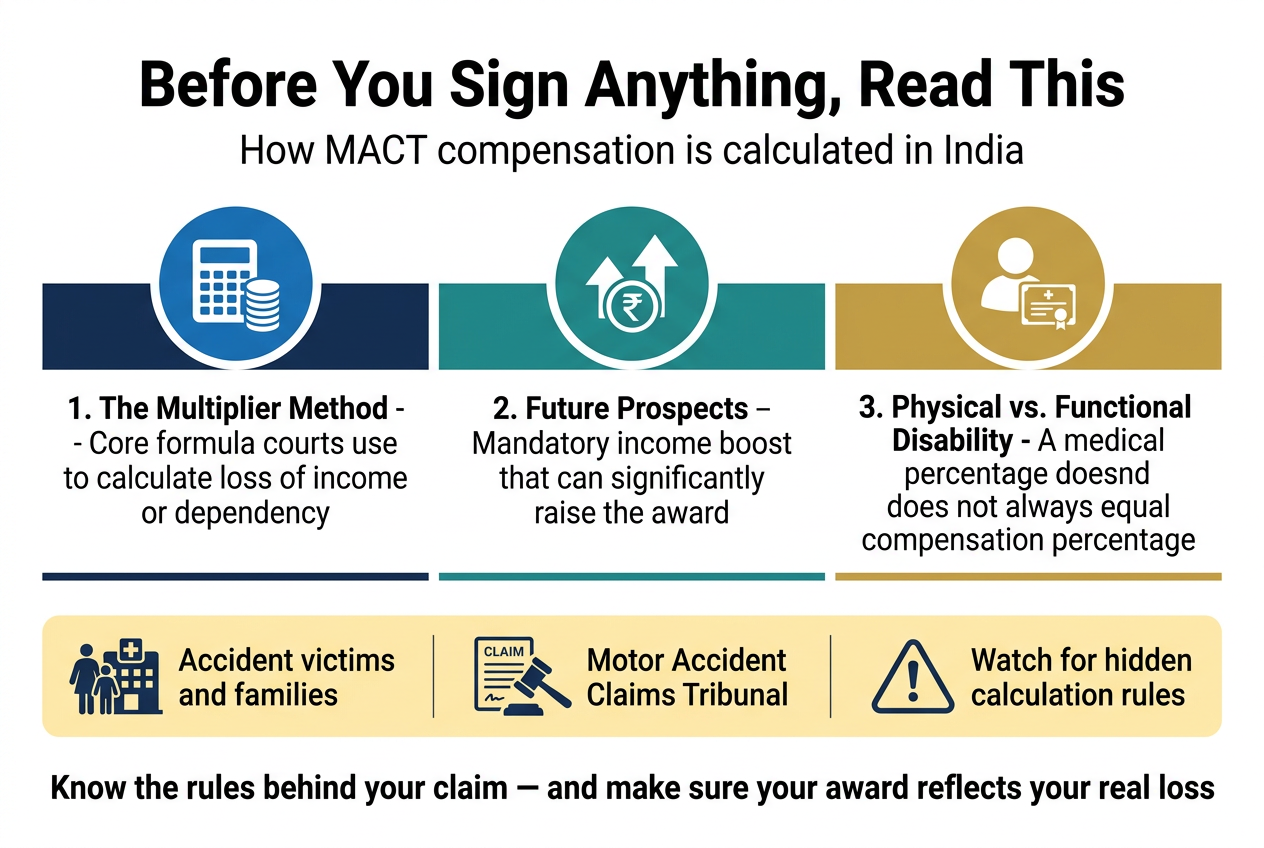
Before You Sign Anything, Read This
If you or someone in your family has been through a road accident in India, you already know how disorienting the legal process feels. One day you’re dealing with hospitals and police reports, and the next, someone hands you a claim form and expects you to understand how the Motor Accident Claims Tribunal calculates what your loss is actually worth.
Here’s the thing — most claimants leave money on the table. Not because their case is weak, but because they don’t know how MACT compensation calculations actually work behind the scenes.
This guide is for accident victims, their families, and anyone currently fighting a claim before the Motor Accident Claims Tribunal in India. Whether you lost a loved one or are dealing with a permanent disability, the numbers in your final award depend on rules most people never see coming.
Here’s what we’ll walk through:
- The Multiplier Method — the core formula courts use to put a number on your loss of income or dependency
- Future Prospects — the mandatory income booster that many tribunals quietly skip, and how it could significantly raise your award
- Physical vs. Functional Disability — why a 60% medical certificate doesn’t always mean 60% compensation, and how courts look at your actual job to decide the real number
By the end, you’ll have a clear picture of how MACT compensation is calculated — and what to watch out for so your claim reflects your real loss.
The Multiplier Method: The Core Formula Behind MACT Awards
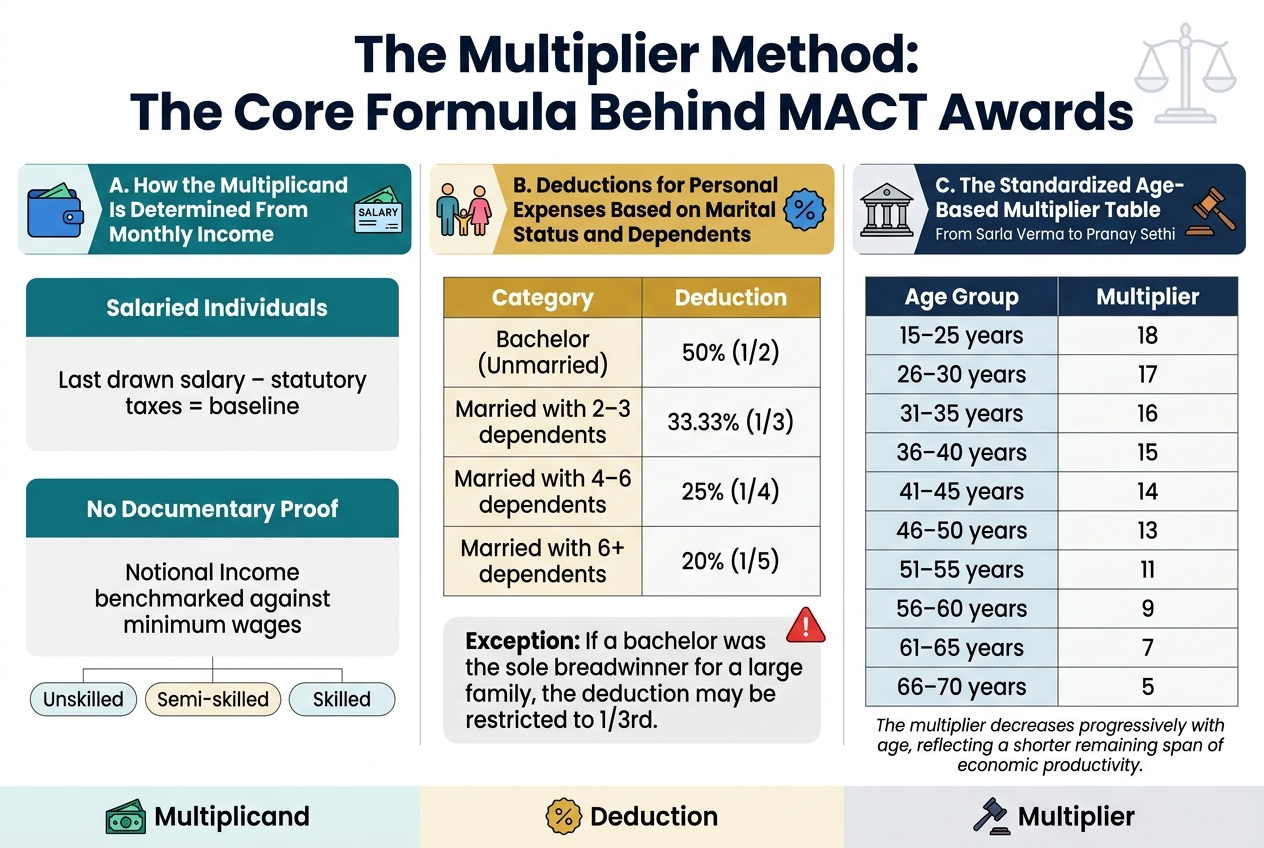
A. How the Multiplicand Is Determined From Monthly Income
The multiplicand represents the deceased’s annual financial contribution to their family. For salaried individuals, the last drawn salary (minus statutory taxes) serves as the baseline. When documentary proof is unavailable, Tribunals apply Notional Income, benchmarked against minimum wages for unskilled, semi-skilled, or skilled labor categories.
B. Deductions for Personal Expenses Based on Marital Status and Dependents
A percentage is deducted to account for the deceased’s personal expenses before calculating the final award:
| Category | Deduction |
|---|---|
| Bachelor (Unmarried) | 50% (1/2) |
| Married with 2–3 dependents | 33.33% (1/3) |
| Married with 4–6 dependents | 25% (1/4) |
| Married with 6+ dependents | 20% (1/5) |
Exception: If a bachelor was the sole breadwinner for a large family, the deduction may be restricted to 1/3rd.
C. The Standardized Age-Based Multiplier Table From Sarla Verma to Pranay Sethi
With this in mind, the multiplier is strictly age-based, codified by the Supreme Court in Sarla Verma (2009) and affirmed in Pranay Sethi (2017):
| Age Group | Multiplier |
|---|---|
| 15–25 years | 18 |
| 26–30 years | 17 |
| 31–35 years | 16 |
| 36–40 years | 15 |
| 41–45 years | 14 |
| 46–50 years | 13 |
| 51–55 years | 11 |
| 56–60 years | 9 |
| 61–65 years | 7 |
| 66–70 years | 5 |
The multiplier decreases progressively with age, reflecting a shorter remaining span of economic productivity.
Future Prospects: The Hidden Booster That Increases Your Compensation
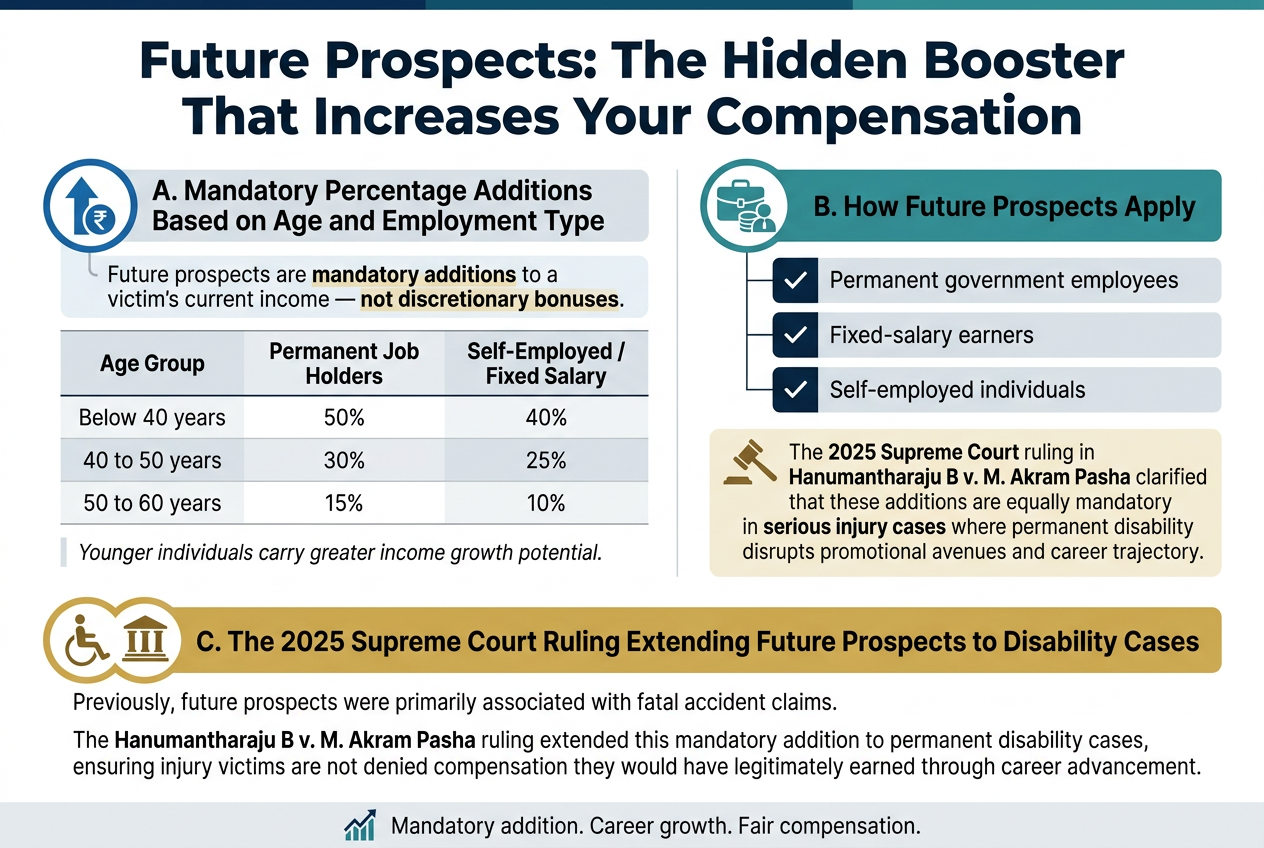
A. Mandatory Percentage Additions Based on Age and Employment Type
Established in Pranay Sethi, future prospects are mandatory additions to a victim’s current income — not discretionary bonuses.
| Age Group | Permanent Job Holders | Self-Employed / Fixed Salary |
|---|---|---|
| Below 40 years | 50% | 40% |
| 40 to 50 years | 30% | 25% |
| 50 to 60 years | 15% | 10% |
This tiered structure reflects a straightforward principle: younger individuals carry greater income growth potential.
B. How Future Prospects Apply to Salaried, Self-Employed, and Injury Victims
Future prospects apply across three categories:
- Permanent government employees
- Fixed-salary earners
- Self-employed individuals
With this in mind, the 2025 Supreme Court ruling in Hanumantharaju B v. M. Akram Pasha clarified that these additions are equally mandatory in serious injury cases where permanent disability disrupts promotional avenues and career trajectory.
C. The 2025 Supreme Court Ruling Extending Future Prospects to Disability Cases
Previously, future prospects were primarily associated with fatal accident claims. The Hanumantharaju B v. M. Akram Pasha ruling decisively extended this mandatory addition to permanent disability cases, ensuring injury victims are not denied compensation they would have legitimately earned through career advancement.
Physical Disability vs. Functional Disability: The Critical Distinction Courts Use
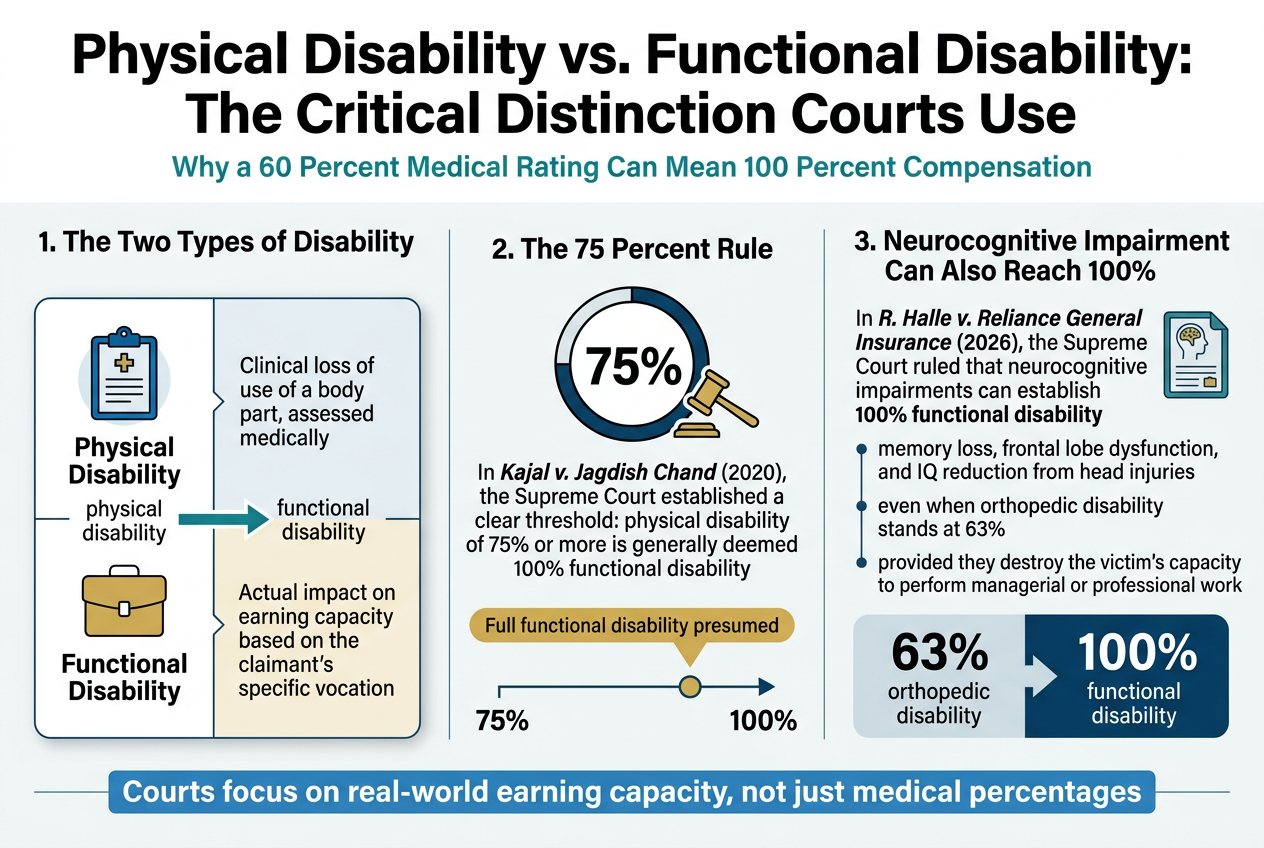
Why a 60 Percent Medical Rating Can Mean 100 Percent Compensation
Courts distinguish between two types of disability:
| Type | Definition |
|---|---|
| Physical Disability | Clinical loss of use of a body part, assessed medically |
| Functional Disability | Actual impact on earning capacity based on the claimant’s specific vocation |
A professional driver with a 60% physical leg disability may receive 100% functional disability compensation — because they simply cannot drive. The same injury in a desk-bound software engineer would yield a lower functional disability rating.
The 75 Percent Rule and When Full Functional Disability Is Presumed
In Kajal v. Jagdish Chand (2020), the Supreme Court established a clear threshold: a physical disability of 75% or more is generally deemed 100% functional disability. This removes ambiguity and protects severely injured claimants from under-compensation.
How Neurocognitive Impairments Can Trigger 100 Percent Functional Disability
With this in mind, physical ratings alone don’t tell the full story. In R. Halle v. Reliance General Insurance (2026), the Supreme Court ruled that neurocognitive impairments — including memory loss, frontal lobe dysfunction, and IQ reduction from head injuries — can establish 100% functional disability even when orthopedic disability stands at 63%, provided they destroy the victim’s capacity to perform managerial or professional work.
Conventional Heads and Expanded Consortium Rights Every Family Must Know
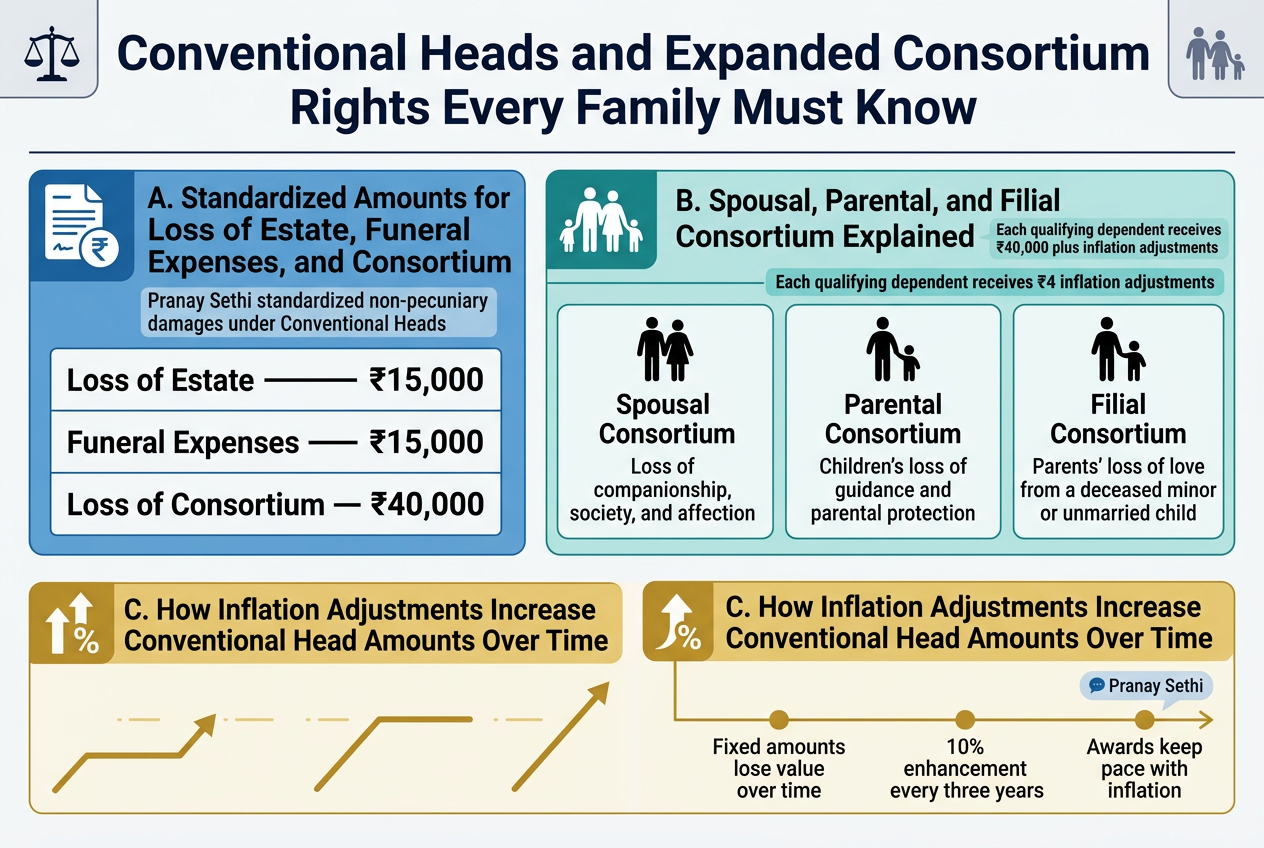
A. Standardized Amounts for Loss of Estate, Funeral Expenses, and Consortium
The Pranay Sethi judgment brought much-needed consistency by standardizing non-pecuniary damages under Conventional Heads:
| Head | Base Amount |
|---|---|
| Loss of Estate | ₹15,000 |
| Funeral Expenses | ₹15,000 |
| Loss of Consortium | ₹40,000 |
B. Spousal, Parental, and Filial Consortium Explained With Per-Dependent Awards
Now that we have covered base amounts, understanding consortium’s expanded scope is equally critical. Cases like Magma General Insurance Co. Ltd. v. Nanu Ram (2018) and United India Insurance Co. Ltd. v. Satinder Kaur (2020) transformed consortium from a purely spousal right into a familial right:
- Spousal Consortium: Loss of companionship, society, and affection
- Parental Consortium: Children’s loss of guidance and parental protection
- Filial Consortium: Parents’ loss of love from a deceased minor or unmarried child
Critically, courts award ₹40,000 (plus inflation adjustments) to each qualifying dependent.
C. How Inflation Adjustments Increase Conventional Head Amounts Over Time
Previously, fixed amounts quickly lost real value. Pranay Sethi addressed this by mandating a 10% enhancement every three years, ensuring conventional head awards keep pace with inflation over time.
Special Categories That Change How Compensation Is Calculated
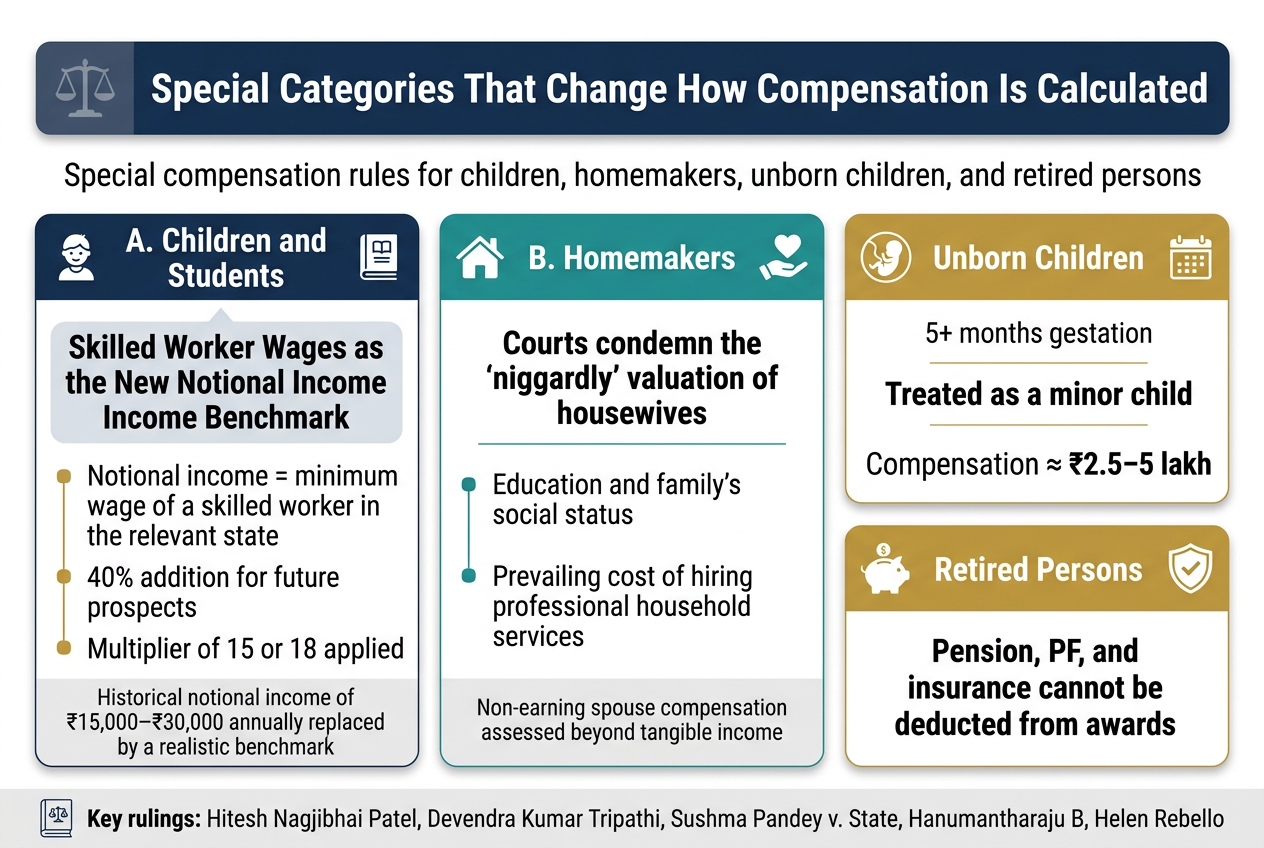
A. Children and Students: Skilled Worker Wages as the New Notional Income Benchmark
Courts historically assigned minimal notional income to children — as low as ₹15,000–₹30,000 annually. The Supreme Court reversed this in Hitesh Nagjibhai Patel and Devendra Kumar Tripathi (2024–2025), mandating:
- Notional income = minimum wage of a skilled worker in the relevant state
- 40% addition for future prospects
- Multiplier of 15 or 18 applied
This acknowledges every child’s realistic potential to become, at minimum, a skilled workman upon majority.
B. Homemakers: How Courts Assess Non-Earning Spouses Beyond Tangible Income
In Sushma Pandey v. State (2024), the Supreme Court condemned the “niggardly” valuation of housewives. A homemaker’s notional income is now assessed considering:
- Education and family’s social status
- Prevailing cost of hiring professional household services
C. Unborn Children, Retired Persons, and Why Pension Cannot Be Deducted
With this in mind, two further categories deserve attention:
| Category | Key Rule |
|---|---|
| Unborn child (5+ months gestation) | Treated as a minor child; compensation ≈ ₹2.5–5 lakh |
| Retired persons | Pension, PF, and insurance cannot be deducted from awards (Hanumantharaju B, 2025; Helen Rebello, 1999) |
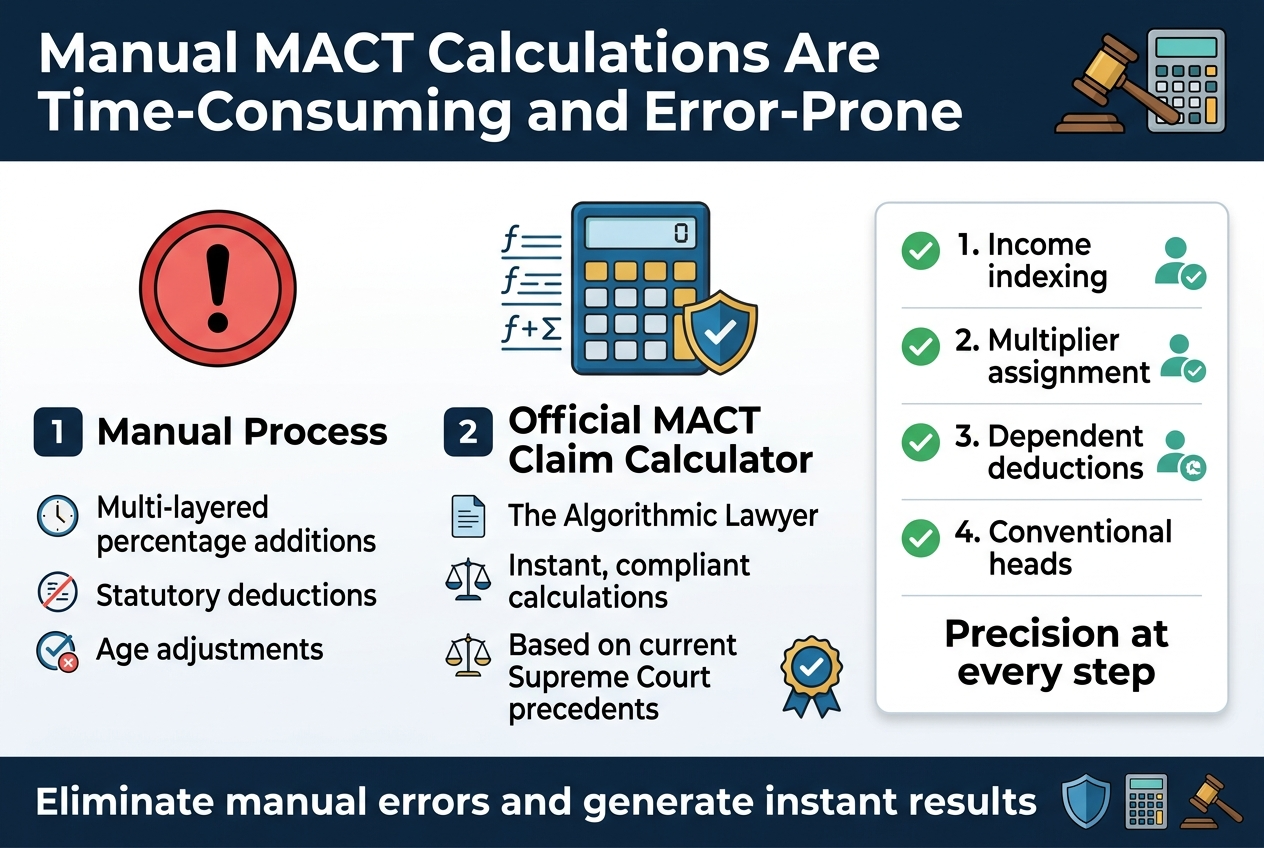
Manual calculations involving multi-layered percentage additions, statutory deductions, and age adjustments can be time-consuming and error-prone.
To eliminate manual errors and generate instant, compliant calculations based on current Supreme Court precedents, use the official MACT Claim Calculator on The Algorithmic Lawyer. It automatically handles income indexing, multiplier assignment, dependent deductions, and conventional heads with precision.
Why Manual MACT Calculations Go Wrong
MACT compensation involves stacking multiple variables — income indexing, age-based multipliers, dependent deductions, percentage additions for future prospects, and separate conventional heads. Miss one step or apply the wrong multiplier, and the entire figure shifts significantly.
Common errors in manual calculations include:
- Applying outdated multiplier tables instead of the current Supreme Court schedule
- Forgetting to add the 40% or 25% future prospects enhancement before computing the annual loss
- Deducting the wrong percentage for personal expenses based on dependent count
- Miscalculating disability percentages when functional loss differs from medical assessment
- Omitting consortium amounts for parents, siblings, or minor children
Use the MACT Claim Calculator on The Algorithmic Lawyer
The MACT Claim Calculator on The Algorithmic Lawyer removes all of that guesswork. It handles:
| Feature | What It Does |
|---|---|
| Income Indexing | Adjusts notional income to current minimum wage norms |
| Multiplier Assignment | Auto-selects the correct multiplier based on claimant’s age |
| Dependent Deduction | Applies the right percentage based on family size |
| Conventional Heads | Adds funeral, loss of estate, and consortium amounts automatically |
The result is a court-ready, precedent-compliant compensation figure — generated in seconds.
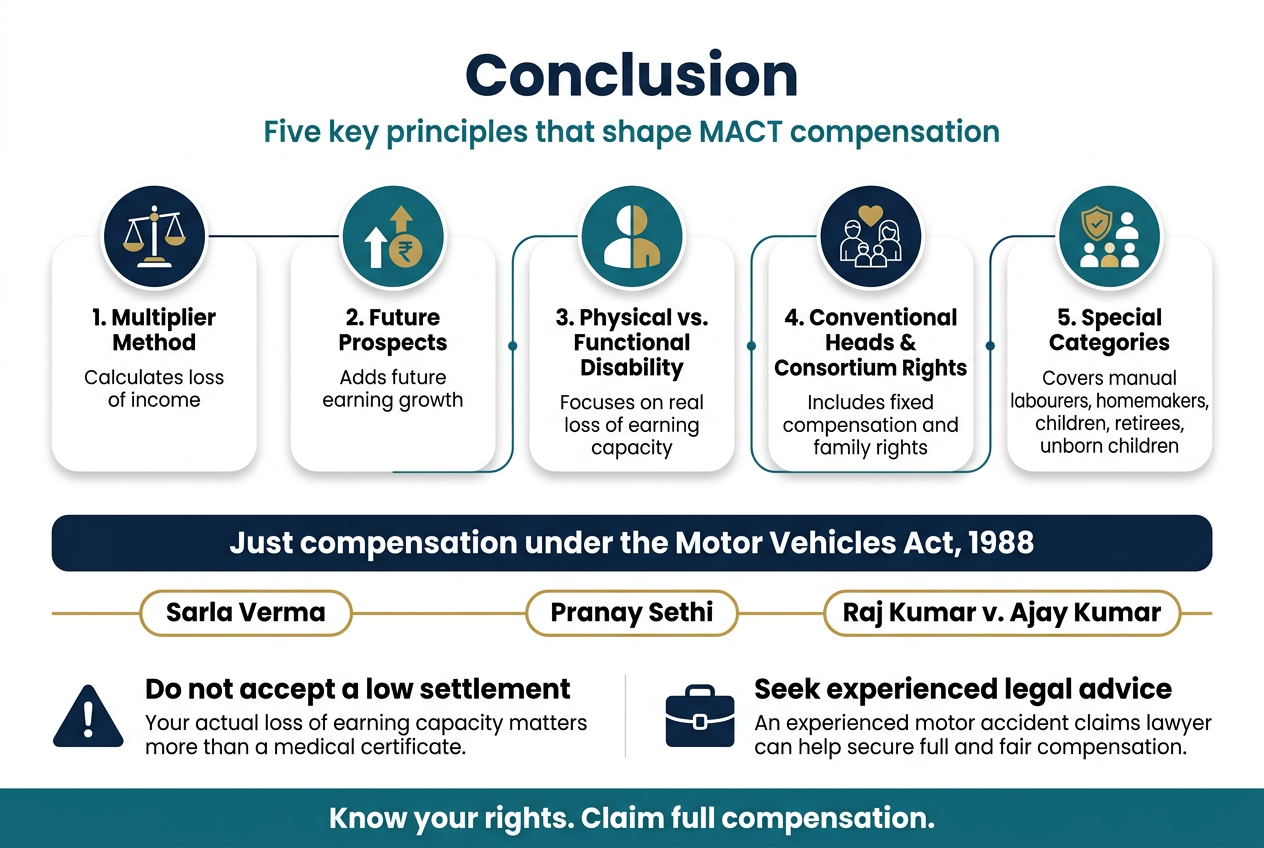
Understanding how MACT compensation is calculated can make a significant difference in the outcome of your claim. The five key elements covered in this blog — the Multiplier Method, Future Prospects, Physical vs. Functional Disability, Conventional Heads and Consortium Rights, and Special Categories — work together to determine what constitutes “just compensation” under the Motor Vehicles Act, 1988. Landmark rulings like Sarla Verma, Pranay Sethi, and Raj Kumar v. Ajay Kumar have built a structured, evidence-based framework that protects victims across all walks of life, from manual labourers and homemakers to children, retirees, and even unborn children.
If you or your family has been affected by a motor accident, knowing these principles is your first line of defense. Do not accept a low settlement without understanding how your actual loss of earning capacity — not just a medical certificate — should drive the compensation. Ensure that future prospects are added, that functional disability is properly assessed for your specific vocation, and that every eligible family member claims their consortium rights. Given the complexity of MACT proceedings and the evolving nature of this law, consulting an experienced motor accident claims lawyer can help you secure the full and fair compensation that the law entitles you to.