
THE ALGORITHMIC LAWYER · KNOW YOUR POLICY
Great Lakes: A Florida Grounding, a Policy Choosing New York Law
Supreme Court of the United States · 21 February 2024
a) The Facts: A Grounding and an Unrelated Fire-System Dispute
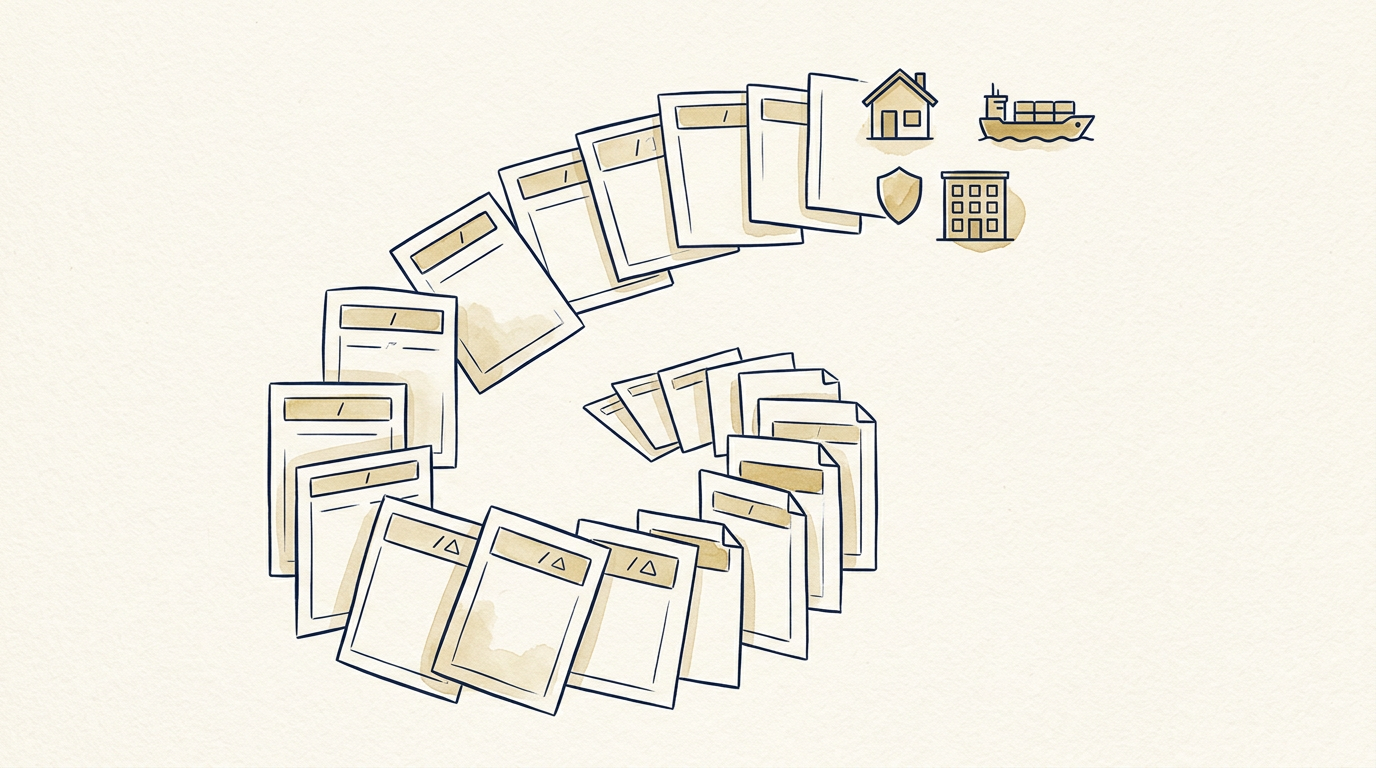
- Raiders Retreat’s boat ran aground in Florida. Great Lakes refused the marine insurance claim, alleging a breach involving the fire-suppression system. That alleged breach was unrelated to the grounding.
- The policy said New York law would govern disputes. Raiders, based in Pennsylvania, brought claims relying on Pennsylvania law. The U.S. Supreme Court decided which law-selection rule applied—not the final amount payable under the policy.1
b) Both Sides’ Arguments: New York Law or Pennsylvania’s Rules?

- Great Lakes: the parties’ agreed choice of New York law should be enforced. A consistent federal maritime rule would make shipping contracts more predictable.
- Raiders: state insurance law should govern. It argued against a general federal rule, sought special treatment for marine insurance and said Pennsylvania’s public policy justified setting aside the agreed choice.2
c) The Court’s Reasons: Why the Agreed Choice of Law Stood

- Could Pennsylvania’s public policy displace the New York-law clause? The Court said no on the proposed basis.
- The main reason for the decision (ratio decidendi): federal maritime law normally enforces the parties’ choice of law, subject to narrow exceptions. Raiders’ proposed extra exception—based on the policy of the state with the greatest interest—would undermine that rule’s predictability.
- The Court discussed limits involving controlling federal legislation, established federal maritime policy and a chosen jurisdiction with no reasonable basis. None justified Raiders’ proposed result here.
- Wider observations (obiter dictum): No clearly separate passage is singled out from the majority opinion. Separately, Justice Thomas agreed with the decision but wrote separately to criticise the foundations and continuing reach of Wilburn Boat. Those were separate concurring observations, not a majority decision overruling that case. They should not be presented as the Court’s binding reason.3
d) The Parties’ Earlier Cases: Why Wilburn Boat Did Not Decide This

- Raiders relied on Wilburn Boat, a marine insurance case applying state law to a warranty issue. The Court distinguished it: that dispute did not involve an agreed choice-of-law clause.
- The argument for maritime uniformity drew on Kirby and related decisions. The Court rejected treating marine insurance as a general exception to the enforceability of agreed law-selection clauses.4
f) The Rules: Choosing the Law Is Different from Choosing the Court

- Choice of law: which legal rules will be used to read the contract. Here the parties selected New York law.
- Choice of forum: where a dispute will be heard. That is a different question, although the Court used earlier forum-clause cases as a helpful comparison.
- A policy condition and the chosen law: first identify the law governing the agreement; then examine what that law does with the disputed condition. This appeal did not settle whether every unrelated breach can defeat a marine claim.5
g) The Evidence: The Policy Clause at the Centre of the Appeal
- The New York-law clause was central. The Court also considered how the dispute had reached it: the trial court had enforced the clause, but the Third Circuit allowed a possible Pennsylvania-policy exception.
- The grounding and alleged fire-system breach supplied the background. The Supreme Court did not carry out a fresh investigation of the casualty or value the damage.6
h) Earlier Judgments: Why Maritime Contracts Need Predictable Rules

- The Bremen and Carnival Cruise Lines supported the comparison with contractual clauses choosing where disputes are heard: respecting the agreement reduces uncertainty.
- Kirby supported uniform maritime rules. Wilburn Boat was distinguished, not overruled.
- Knott and The Kensington informed the limits imposed by federal law and maritime policy. The official opinion explains how these authorities fit the rule and its exceptions.7
i) The Decision: The Case Returned, Without a Final Coverage Award
- The Court unanimously reversed the Third Circuit and sent the case back for further proceedings consistent with its ruling.
- It did not order a quantified insurance payment or decide a universal rule about unrelated equipment breaches.8
j) The Lesson: Identify the Governing Law Before Arguing Cover

- The agreed legal rulebook mattered before the Court could reach the underlying insurance dispute.
- For this contract, a different state’s preferred insurance policy was not enough to undo the parties’ agreed choice. The final coverage dispute still required further proceedings.9
Volcafe: The Coffee Arrived Wet—Who Had to Explain Why?
Supreme Court of the United Kingdom · 5 December 2018
a) The Facts: Condensation Damaged Coffee in 18 Containers
- Coffee was shipped from Colombia to Germany in 20 unventilated containers. The carrier had agreed to prepare the containers and load the bags. When opened at Bremen, bags in 18 containers had water damage from condensation.
- Coffee releases moisture. When warm cargo travels into a cooler climate, water can collect inside the container. Kraft paper was used to protect these shipments; the dispute concerned whether the protection had been adequate.10
b) Both Sides’ Arguments: Natural Moisture or Inadequate Protection?
- The cargo owners: the carrier failed to deliver the coffee in the good condition recorded on shipment and failed to take proper care of it.
- The carrier: the coffee’s own moisture characteristics caused the damage. It relied on the exception for “inherent vice”—damage arising from the goods’ own nature—and said the owners had to prove negligent care once that exception was shown.
- The owners answered that the carrier still had to show proper care. Calling the problem a natural characteristic of coffee did not prove that adequate protection could not have prevented it.11
c) The Court’s Reasons: The Carrier Had to Prove Proper Care
- Who had to prove that proper care was taken? Could the carrier answer the claim simply by pointing to the coffee’s tendency to release moisture?
- The main reason for the decision (ratio decidendi): the carrier had the legal burden of showing reasonable care. To rely on the goods’ own characteristics, it had to show that reasonable care would not have prevented the damage. It had not established the necessary facts about adequate protective lining.
- The Supreme Court also rejected the appeal court’s replacement of the trial judge’s findings about the evidence. It restored the trial result.
- Wider observations (obiter dictum): no clearly separate passage is singled out here. In particular, the alternative reasoning about the carrier’s defence forms part of the Court’s analysis; it should not casually be relabelled as a passing comment.12
d) The Parties’ Earlier Cases: Why The Glendarroch Did Not Settle Proof
- The carrier relied strongly on The Glendarroch to support its argument about who had to prove negligence. The Court rejected using that decision as a general rule governing this Hague Rules dispute.
- Even on the alternative approach considered by the Court, pointing to the goods’ natural characteristics did not establish the defence without addressing reasonable care.13
f) The Rules: Natural Cargo Characteristics Do Not End the Care Question
- Custody of someone else’s goods: the legal term is “bailment.” The carrier had taken charge of the coffee and had duties concerning its care.
- Hague Rules, article III, rule 2: the carrier must properly and carefully handle, carry and care for the cargo.
- Article IV, rule 2(m): the rules recognise damage arising from the goods’ own nature. Here that exception had to be read alongside the duty to care for the coffee.
- Carrier responsibility and insurance: this judgment decided the claim against the carrier. It did not decide whether a particular cargo insurance policy had to pay.14
g) The Evidence: What Was Actually Proved About the Protective Paper?
- The Court examined the shipping documents, the coffee’s condition on arrival, photographs, pre-loading material and expert evidence, including a joint memorandum.
- The trial evidence did not establish the paper weight, number of layers or a consistent protective practice needed to support the carrier’s case. The Court would not replace those gaps with assumptions about what must have been done.
- Inspectors’ comments were also considered, but they did not resolve the disputed protective arrangements. These materials were evidence in the carrier claim, not a final insurance loss valuation.15
h) Earlier Judgments: Who Must Explain Damage to Goods in Their Care?
- Gosse Millard, Silver and The Torenia supported the analysis of care and proof when goods are in another’s custody.
- Albacora and The Bunga Seroja were examined critically on the burden of proof. The Court did not treat every statement in those cases as a rule to follow.
- The Glendarroch did not establish the contrary general burden rule the carrier needed. The judgment explains both its rejection and the alternative reasoning.16
i) The Decision: The Cargo Owners Won Their Appeal
- The Supreme Court allowed the cargo owners’ appeal and restored the deputy judge’s order.
- The result concerned carrier liability. It was not an award under a cargo insurance policy.17
j) The Lesson: Ask What Protection Was Needed—and What Was Provided
- Knowing that coffee releases moisture starts the explanation; it does not finish it. The next question is what protection reasonable care required and what protection was actually proved.
- The carrier could not fill gaps in that proof by putting the whole problem down to the nature of coffee.18
Resources and footnotes
- Great Lakes Ins. SE v. Raiders Retreat Realty Co., No. 22-500, slip op. at 1–3 (U.S. Feb. 21, 2024). Official judgment. ↩
- Great Lakes Ins. SE v. Raiders Retreat Realty Co., No. 22-500, slip op. at 7–13 (U.S. Feb. 21, 2024). Official judgment. ↩
- Great Lakes Ins. SE v. Raiders Retreat Realty Co., No. 22-500, slip op. at 3–13 (U.S. Feb. 21, 2024); Thomas, J., concurring, slip op. at 1–7. Official judgment. ↩
- Great Lakes Ins. SE v. Raiders Retreat Realty Co., No. 22-500, slip op. at 7–10 (U.S. Feb. 21, 2024). Official judgment. ↩
- Great Lakes Ins. SE v. Raiders Retreat Realty Co., No. 22-500, slip op. at 4–6, 10–12 (U.S. Feb. 21, 2024). Official judgment. ↩
- Great Lakes Ins. SE v. Raiders Retreat Realty Co., No. 22-500, slip op. at 1–3 (U.S. Feb. 21, 2024). Official judgment. ↩
- Great Lakes Ins. SE v. Raiders Retreat Realty Co., No. 22-500, slip op. at 3–13 (U.S. Feb. 21, 2024). Authorities discussed there: Wilburn Boat Co. v. Fireman’s Fund Ins. Co., 348 U.S. 310 (1955); The Bremen v. Zapata Off-Shore Co., 407 U.S. 1 (1972); Carnival Cruise Lines, Inc. v. Shute, 499 U.S. 585 (1991); Norfolk S. Ry. Co. v. James N. Kirby, Pty Ltd., 543 U.S. 14 (2004); Knott v. Botany Mills, 179 U.S. 69 (1900); The Kensington, 183 U.S. 263 (1902).. Official judgment. ↩
- Great Lakes Ins. SE v. Raiders Retreat Realty Co., No. 22-500, slip op. at 13 (U.S. Feb. 21, 2024). Official judgment. ↩
- Great Lakes Ins. SE v. Raiders Retreat Realty Co., No. 22-500, slip op. at 3–13 (U.S. Feb. 21, 2024). Official judgment. ↩
- Volcafe Ltd. v. Compania Sud Americana de Vapores SA, [2018] UKSC 61, ¶¶ 2–5 (appeal taken from Eng.). Official judgment. ↩
- Volcafe Ltd. v. Compania Sud Americana de Vapores SA, [2018] UKSC 61, ¶¶ 4–5, 14–15, 28–34 (appeal taken from Eng.). Official judgment. ↩
- Volcafe Ltd. v. Compania Sud Americana de Vapores SA, [2018] UKSC 61, ¶¶ 14–37, 38–44 (appeal taken from Eng.). Official judgment. ↩
- Volcafe Ltd. v. Compania Sud Americana de Vapores SA, [2018] UKSC 61, ¶¶ 28–34 (appeal taken from Eng.). Official judgment. ↩
- Volcafe Ltd. v. Compania Sud Americana de Vapores SA, [2018] UKSC 61, ¶¶ 14–28, 35–37 (appeal taken from Eng.). Official judgment. ↩
- Volcafe Ltd. v. Compania Sud Americana de Vapores SA, [2018] UKSC 61, ¶¶ 5–12, 38–44 (appeal taken from Eng.). Official judgment. ↩
- Volcafe Ltd. v. Compania Sud Americana de Vapores SA, [2018] UKSC 61, ¶¶ 14–37 (appeal taken from Eng.). Authorities discussed there: Gosse Millard Ltd. v. Canadian Gov’t Merchant Marine Ltd., [1927] 2 K.B. 432; Silver v. Ocean Steamship Co., [1930] 1 K.B. 416; The Torenia, [1983] 2 Lloyd’s Rep. 210; Albacora S.R.L. v. Westcott & Laurance Line Ltd., 1966 S.C. (H.L.) 19; The Bunga Seroja, [1999] 1 Lloyd’s Rep. 512; The Glendarroch, [1894] P. 226.. Official judgment. ↩
- Volcafe Ltd. v. Compania Sud Americana de Vapores SA, [2018] UKSC 61, ¶ 44 (appeal taken from Eng.). Official judgment. ↩
- Volcafe Ltd. v. Compania Sud Americana de Vapores SA, [2018] UKSC 61, ¶¶ 35–44 (appeal taken from Eng.). Official judgment. ↩
Credits: source courts and judicial authors are credited in the notes. GravityWrite assisted with article drafting and heading suggestions, and generated the conceptual illustrations; the text was edited and checked against the cited records. Earlier cases are described as discussed in those judgments; independent full-text checks of every earlier authority are not claimed. Illustrations are not photographs of the events, court documents or evidence. By The Algorithmic Lawyer.